NOT BOMBS
August 10, 2026
Children were racing around the stubbly lawn outside the yellow-brick public housing projects on Portland Avenue in Cambridge, Massachusetts, when I pulled up to the curb in the Dodge van with my friend Sue Eaton, dubbed ‘Emma’ after the anarchist Emma Goldman. I slid open the side door and lifted out the first box of wilted and bruised produce I had removed that morning from the bins at Bread and Circus Natural Grocery when I was setting up the produce display.
I had been delivering cases of recovered fruit and vegetables to the mothers who lived in the poorly maintained housing project several days a week for months. A seven-story glass building and concrete parking garage had been under construction in the northwest corner of the vast, barren property behind the Massachusetts Institute of Technology.
“Keith, we just learned that that new building is a nuclear weapons lab called Draper,” said one of the women filling her grocery bag with my recovered produce.
Later that week, I designed a flyer for our new group we were calling the Food For Free Committee. News of the nuclear weapons facility inspired the headline “Food Not Bombs,” followed by the subhead, “We never sell out.”
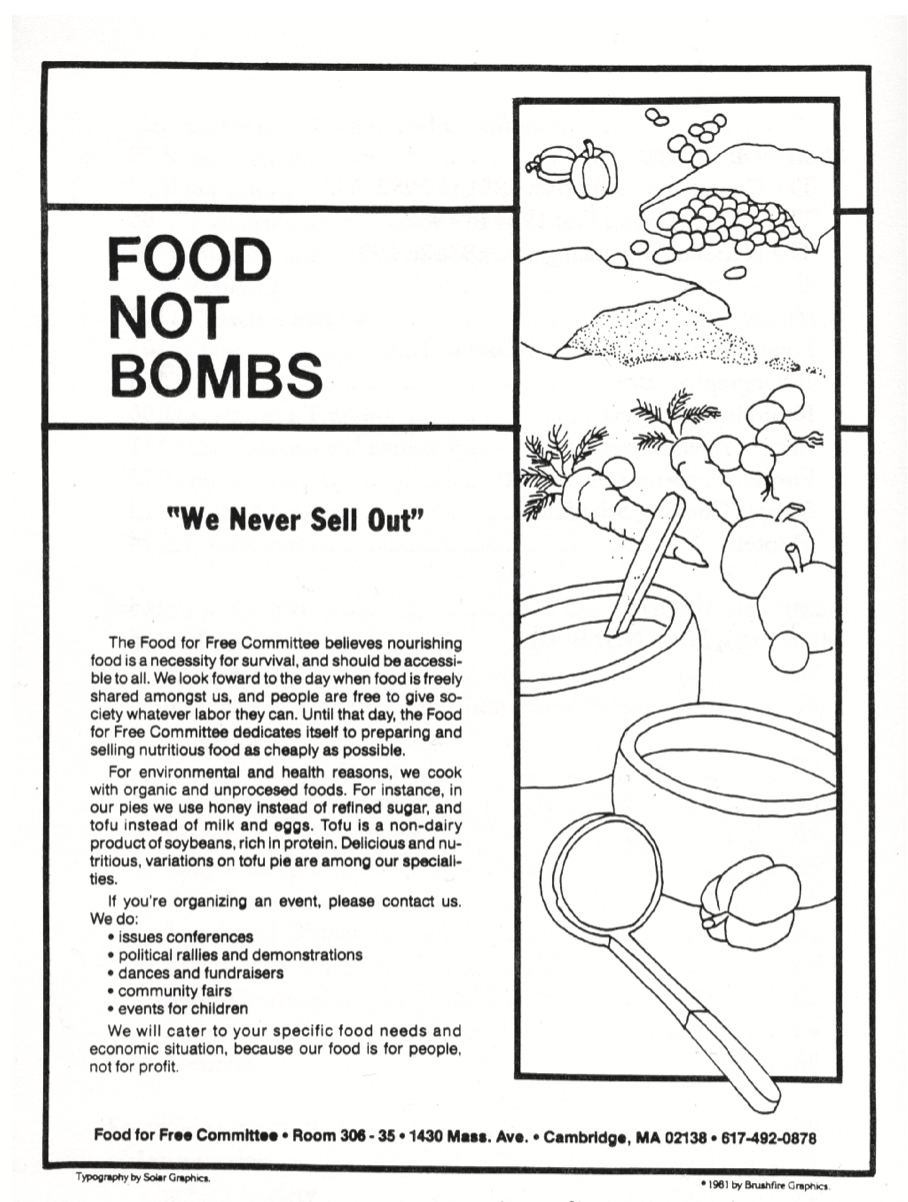
We agreed to change the name of our group to Food Not Bombs that week as we prepared baked goods to raise money to pay back the generous man who bailed out Brian Feigenbaum when Brian was arrested during the May 24, 1980, Occupation Attempt of the Seabrook Nuclear Power Station construction site.
When our group started, antinuclear activists were talking about Lyall Watson’s “hundredth monkey” theory that he wrote of in his 1979 book, Lifetide: The biology of the unconscious. The hundredth monkey effect is the idea claiming that a new behavior, like monkeys all over the world suddenly washing their food, could spread rapidly by unexplained means from one group to all related groups once a critical number of members of one group exhibit the new behavior or adopt a new idea. Our hope was that every time people announced that Food Not Bombs had arrived to pick up the surplus groceries or saw our banner, as in Watson’s theory, the idea would take hold and the public would organize to divert military spending to domestic programs.
The message of Food Not Bombs is needed more today than at any time in our 46-year history. Trump is asking Congress for an historic $1.5 trillion defense budget in fiscal 2027. The president, in a July 31, 2026, cabinet meeting at Camp David, highlighted what he called the “unprecedented investment” in the U.S. military and said he was “looking forward” to the $1.5 trillion.
“People see now how important it is,” Trump said of the amount. “We want to keep a safe country.”
The billions “invested” already in the U.S. military failed to provide enough missiles to continue Trump’s regime-change war of choice against Iran.
Those trillions spent on the Pentagon could have kept the country safe from hunger and homelessness. And that is the point of having started the first Food Not Bombs collective in 1980.
In an April 2009 speech aired on C-SPAN, one of Obama’s State Department officials, in a lecture at Tufts University, warned of the threat to America’s national security by the people who share vegan meals in America’s parks.
The speaker compared the people sharing the vegan food to Al-Qaeda, asking who was more dangerous. His conclusion was that the people sharing meals were more dangerous because they were friendly people local to their community and were likely to continue their work for another 30 years, while Al-Qaeda wouldn’t be around in another two decades “because who really wants to strap bombs to themselves and die.”
He feared that the people sharing the vegan meals were influencing the public to support the policy that “money should be diverted from the military to fund healthcare, education and other social services,” making it more difficult to pay for the wars against groups like Al-Qaeda.
Soup Street — A memoir by Food Not Bombs co-founder Keith McHenry
https://foodnotbombs.net/soup_street.html


