I live in the United States of America
September 25, 2021

I live in the United States of America.
Clouds tumbled slowly over my beach town Santa Cruz as I arrived at Lot 27, home to the daily Food Not Bombs meal. The first thing that caught my eye was the new bright white canopy with walls that hugged the Credit Union wall.
The proud owner was a family of four that had returned to Santa Cruz the day before just in time to snag this palace of a donation.
The mother of the house smiled as she told of her families effort to find a place in Nevada and several other states. “It’s the same every where we went so we just came back.” Her son reminds me that he had volunteered with Food Not Bombs when we shared at the downtown Post Office. He asked if I could get a larger tent for them. All four we stuffed into a two person pup tent sheltered by the canopy.
Friends joined me to report the events of our asphalt dining room that I had missed the day before. We needed to restock the larger plates and another friend needed money to buy another green canister of propane for their Coleman so they could make coffee in the morning. Our coffee arrives at noon.
Two more friends come to let me know the police had come to their tent that clung to a patch of dry grass along the levee that morning telling them they would have to leave by Monday. They asked the officers where they should move and the police didn’t know but suggested they might try the San Lorenzo Park Benchlands where a few hundred other people were already camping.
Another friend drives into the parking lot grinning fresh blue tape strengthening the new back window we were able to buy to replace the plastic that had been between his worldly possessions and the thieves of the streets.
Student volunteers join the festival. One has agreed to post our flyers seeking more volunteers around campus so I give her the posters, and J21 staple gun and backup staples. The school year has begun.
My dear activist friend pulls in next to the Food Not Bombs van. We hug that long hug of our friendship. She is delivering a t-shirt she designed “Most of my heroes have done some time in jail” with my name included in a list of revolutionaries. I passed her a few of the Food Not Bombs pot holders she requested and signed page 617 of her hardback copy of “A People’s History of the United States” by Howard Zinn. She didn’t depart until she had made a generous financial donation and another long hug.
More friends arrived several seeking tents to replace the ones that were stolen by a desperate neighbor or trashed by the city.
Than it was time to unload my Honda Pilot of its cases of coffee, coconut oil, sugar and creamer at the kitchen. A loyal occupant of the streets did the heavy lifting. He and I meet a few minuted later at India Joze to move our pallets of that days Second Harvest delivery. One load goes to our shipping container at Laurel and Front Streets. The rice is stored in Joe’s office and the balance fills my car again for the trip to the Benchlands camp.
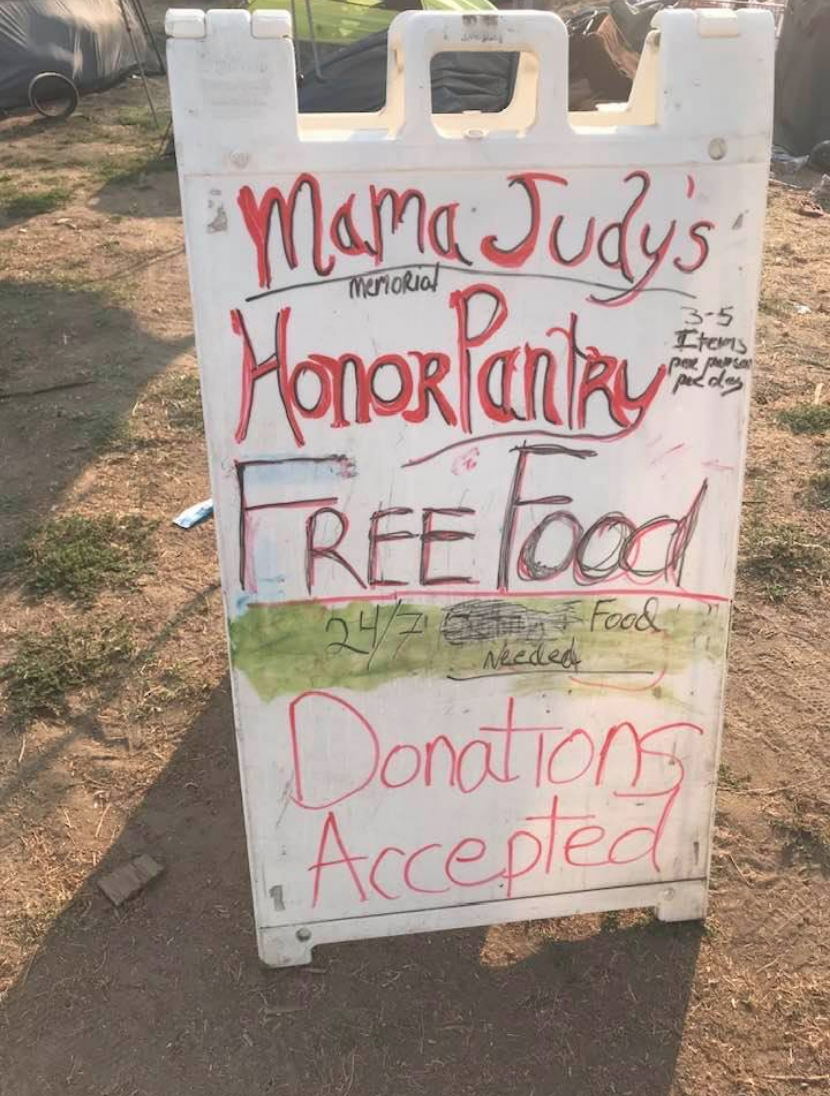
Our staff at the Santa Cruz Homeless Union tent unpacks the first half of the load. I take the other half to “Mama Judy’s Memorial Honor Pantry”. A grumpy camper tells me to screw off when I call out for help and returns to his dismantling of his tiny tent tossing parts into a pile unloved debris.
But a couple of other friends answered the call and the pantry was restocked. A passer by asked if I had water and I let him know I would return with a supply in about an hour.
It was back to the union tent and the collection of empty dusty five gallon water jugs and the run to New Leaf to fill them with filtered water. If you lived in Santa Cruz you would know that the tap water tastes like a mixture of chlorine and allege and that’s what the one faucet in the park provides.
I run into an old friend at the grocery. He tells me he is tired of the police repression in Santa Cruz and plans to leave. The city has seized his vehicular homes twice now. He shared that he lost all his family photos, precious childhood belongings and work tool in the first tow. He lost the replacement tools in the second. He is done with it.
It was another day navigating the country I live in. It wont be long before the Bidenvilles of America will double in size and numbers. This will be a rough winter for millions in the country I live in.
Keith McHenry is working on another book, The Food Terrorist Diaries http://www.foodnotbombs.net
THE LOGIC OF LETTING MILLIONS OF AMERICANS MOVE ONTO THE STREETS
September 7, 2021

On August 24, 2021, The US Supreme Court ruled for a second time this summer that Biden’s eviction moratorium was unconstitutional. Only about $5.1 billion of the $46.5 billion in rent and mortgage relief had been disbursed by the end of July 2021. What is the plan now?
So as predicted, just 20 days after Congresswoman Cori Bush’s stunt on the steps of the US Capital millions of American’s are about to be forced on to the streets. At least 9.4 million workers with be cut off from Pandemic Unemployment Assistance on Labor Day. Millions more Americans could find themselves living under overpasses, parks and doorways this winter. A cruel wave of Bidenville camps are already struggling against the sweeps. Why wasn’t Cori Bush and the Squad pushing for legislation to protect tenants and small landlords on June 1, 2021, when the US Supreme Court first ruled the CDC eviction moratorium was unconstitutional?
We see the tragic consequences here in Santa Cruz, California as our friends panic before their move to a tent along the San Lorenzo River or next to the freeway.
On September 3, 2021, many people at the Oceana Motel and another dozen or more at the Sea Air Hotel in Santa Cruz were forced out of their COVID hotels into the doorways and parks of Santa Cruz California. the ones that did secure temporary housing had to do so on their own without help from the city or county according to a number of those who spoke to me this week.
I received an email from Jessica Scheiner, Housing for Health County of Santa Cruz on August 26, 2021
Due to the shift in our COVID-19 homeless response and changing priorities and staffing, we are discontinuing our COVID-19 Homeless Services Providers Call, so I emailed both Jessica and cc’d her supervisor Dr Robert Ratner asking this question.
Hi Jessica,
Is it true that those unhoused who live in the COVID hotels are being provided housing on September 3rd. I did hear of one friend that did get housing.
Thanks
Keith McHenry
That same day at noon Dr Robert Ratner, Director, Housing for Health Division replied:
Hi Keith – we’re not “providing housing” for all guests. Nearly all guests have an opportunity to secure housing authority housing subsidy vouchers and to receive supportive services. The guests need to make personal decisions about where they want to live given the supports and resources available.
This one friend, Noël who did get housing reported to our Santa Cruz Homeless Union meeting that she got help from the county’s Housing Matters program or Housing for Health. She spent a month seeking her own apartment. Another friend from Sea Air, Nikki has also been seeking a place to live since the announcement of the September 3 evictions. So far no luck. Her car died so she cannot return to her pre-COVID accommodations.
Anthony rolled up to the Food Not Bombs in his electric wheelchair on Sunday to say Housing for Health and the other county agencies have provided no help in his finding a place for him to go after his COVID hotel eviction. He found a place on his own but the landlord wants proof that they will be paid by the county, proof the county so far has not provided.
September has also been a rough month already for those who live in their vehicles. The Santa Cruz Police ran a public relations campaign, Operation Westside Story, where they bragged about towing people’s vehicular homes after aggressively ticketing people until it becomes too expensive for them to register their only safe place to sleep. The police seized 4 RVs and 7 cars in one Westside sweep according to their Facebook publicity. Santa Cruz Homeless Union president Alicia Kuhl was in tears when she called me after witnessing another sweep reporting that the police took a disabled man’s RV, handed him his cane and left him to stand on the side of the street without any of his belongings.
But there is plenty of money in the states coffers to make sure no Californians are forced to live outside. In June 2021 Governor Newsom reported there was around a $75 billion dollar surplus yet these funds have failed to provide rent relief or provide housing for the unhoused. According to the US Department of Housing and Urban Development, it would cost $20 billion to end homelessness in the United States.
Local Santa Cruz leaders claim they ran out of COVID money so the hotel and camp evictions are starting. The city and county managed Golf Course Camp will evict about 60 people in mid September according to people who live there. Unhoused people and their supporters are questioning where the nearly $100 million the county and city of Santa Cruz spends each year goes since there is little evidence of it providing services let alone housing for the thousands that already live outside.
What exactly is the point of the City of Santa Cruz’s Camping Services and Standards Ordinance that makes it a crime to sleep outside unless you are one of the lucky 150 to 200 people who get to participate in the city’s dusk to dawn safe sleeping site in a downtown parking lot? Are they hoping to drive their homeless problem out of town or are they participating in an ominous national strategy? Most local leaders are probably blind to such a strategy and believe they are just following state and federal policies.
So why would Democratic leaders fail to implement any solutions while they control the White House, Senate and Congress? Where was the legislation that the US Supreme Court announced was necessary to prevent millions of people from facing homelessness? They clearly have the money, having given trillions to the billionaire class.
We have known for more than a year that millions of households would be facing eviction and foreclosure yet little has been done to address the crisis. Sure property speculators are pouring millions of dollars into the Democratic Party and this could be at the root of the inaction but there may be something much more sinister behind their refusal to protect the American people.
This is a small example of the funding that has been flooding into the Democratic Party on behalf of the real estate billionaires and their effort to end the eviction moratorium. George Marcus, chairman of both the massive real estate brokerage Marcus & Millichap and the investment firm Essex Property Trust, gave $1 million on June 1, 2021, to House Majority PAC. That was the day the Congress should have been rushing through tenant and landlord protection.
Marcus also donated $263,400 in June to a fundraising committee benefiting Congresswoman Nancy Pelosi’s campaign, her leadership PAC, and the Democratic Congressional Campaign Committee. Executives at Blackstone Group, gave $2.3 million to Senate Majority PAC, $250,000 to House Majority PAC, and $350,000 to Unite the Country, the pro-Biden super PAC. This June Blackstone said it was buying Home Partners of America, a company that owns more than seventeen thousand homes. A Koch Industry lobbyist, Akin Gump Strauss Hauer & Feld, donated $336,500 to the Democrats after buying and managing more than 30,000 homes. Blackstone also became a minority investor in Tricon Residential, which owns more than thirty-thousand single family and multifamily rental homes. Heather Podesta, the former wife of Tony Podesta raised $177,000 for the DSCC and $114,000 for the DCCC this year. Heather is the founder and CEO of Invariant LLC, which lobbies for the National Association of Realtors and NAREIT, and the National Association of Real Estate Investment Trusts. The Podesta Group’s Clients have included Google, Wells Fargo, General Electric, Boeing the Pharmaceutical Research and Manufacturers of America, and the Kingdom of Saudi Arabia. His brother John previously served as White House chief of staff to President Bill Clinton and chaired Hillary Clinton’s campaign for president in 2016.
The National Association of Realtors provided funding for the recall campaign of pro-tenant Santa Cruz City Councilors Chris Krohn and Drew Glover replacing them with their property speculator allies who have since paved the way for the current string of anti-homeless laws and rubber stamped policies that encourage hedge funds to scoop up the seaside community.
But I believe there is possibly a more sinister reason why the Democrats have all but ignored this nation shattering crisis. The DNC organized Capital Steps stunt with Congressperson Cori Bush and Congresses failure to introduce life saving legislation gave me the impression that the government wants there to be millions living outside without access to water, trash collection and toilets.
They could be intentionally forcing a dystopian hell-scape on the American people so that after a winter living in a Mad Max Cyclone the good people of our nation will demand something be done and that something will be the implementation of a total police state and the removal of the unhoused “useless eaters” to those FEMA camps our homeless friends have been warning us of for the past decade. This was the strategy that was useful for the National Socialists of Germany in 1930s and could be a useful strategy for the global predator class of today.
Otherwise why are they forcing millions of people on the cold streets this winter?
THE LOGIC OF FORCING MILLIONS OF AMERICANS MOVE ONTO THE STREETS
September 7, 2021

On August 24, 2021, The US Supreme Court ruled for a second time this summer that Biden’s eviction moratorium was unconstitutional. Only about $5.1 billion of the $46.5 billion in rent and mortgage relief had been disbursed by the end of July 2021. What is the plan now?
So as predicted, just 20 days after Congresswoman Cori Bush’s stunt on the steps of the US Capital millions of American’s are about to be forced on to the streets. At least 9.4 million workers with be cut off from Pandemic Unemployment Assistance on Labor Day. Millions more Americans could find themselves living under overpasses, parks and doorways this winter. A cruel wave of Bidenville camps are already struggling against the sweeps. Why wasn’t Cori Bush and the Squad pushing for legislation to protect tenants and small landlords on June 1, 2021, when the US Supreme Court first ruled the CDC eviction moratorium was unconstitutional?
We see the tragic consequences here in Santa Cruz, California as our friends panic before their move to a tent along the San Lorenzo River or next to the freeway.
On September 3, 2021, many people at the Oceana Motel and another dozen or more at the Sea Air Hotel in Santa Cruz were forced out of their COVID hotels into the doorways and parks of Santa Cruz California. the ones that did secure temporary housing had to do so on their own without help from the city or county according to a number of those who spoke to me this week.
I received an email from Jessica Scheiner, Housing for Health County of Santa Cruz on August 26, 2021
Due to the shift in our COVID-19 homeless response and changing priorities and staffing, we are discontinuing our COVID-19 Homeless Services Providers Call, so I emailed both Jessica and cc’d her supervisor Dr Robert Ratner asking this question.
Hi Jessica,
Is it true that those unhoused who live in the COVID hotels are being provided housing on September 3rd. I did hear of one friend that did get housing.
Thanks
Keith McHenry
That same day at noon Dr Robert Ratner, Director, Housing for Health Division replied:
Hi Keith – we’re not “providing housing” for all guests. Nearly all guests have an opportunity to secure housing authority housing subsidy vouchers and to receive supportive services. The guests need to make personal decisions about where they want to live given the supports and resources available.
This one friend, Noël who did get housing reported to our Santa Cruz Homeless Union meeting that she got help from the county’s Housing Matters program or Housing for Health. She spent a month seeking her own apartment. Another friend from Sea Air, Nikki has also been seeking a place to live since the announcement of the September 3 evictions. So far no luck. Her car died so she cannot return to her pre-COVID accommodations.
Anthony rolled up to the Food Not Bombs in his electric wheelchair on Sunday to say Housing for Health and the other county agencies have provided no help in his finding a place for him to go after his COVID hotel eviction. He found a place on his own but the landlord wants proof that they will be paid by the county, proof the county so far has not provided.
September has also been a rough month already for those who live in their vehicles. The Santa Cruz Police ran a public relations campaign, Operation Westside Story, where they bragged about towing people’s vehicular homes after aggressively ticketing people until it becomes too expensive for them to register their only safe place to sleep. The police seized 4 RVs and 7 cars in one Westside sweep according to their Facebook publicity. Santa Cruz Homeless Union president Alicia Kuhl was in tears when she called me after witnessing another sweep reporting that the police took a disabled man’s RV, handed him his cane and left him to stand on the side of the street without any of his belongings.
But there is plenty of money in the states coffers to make sure no Californians are forced to live outside. In June 2021 Governor Newsom reported there was around a $75 billion dollar surplus yet these funds have failed to provide rent relief or provide housing for the unhoused. According to the US Department of Housing and Urban Development, it would cost $20 billion to end homelessness in the United States.
Local Santa Cruz leaders claim they ran out of COVID money so the hotel and camp evictions are starting. The city and county managed Golf Course Camp will evict about 60 people in mid September according to people who live there. Unhoused people and their supporters are questioning where the nearly $100 million the county and city of Santa Cruz spends each year goes since there is little evidence of it providing services let alone housing for the thousands that already live outside.
What exactly is the point of the City of Santa Cruz’s Camping Services and Standards Ordinance that makes it a crime to sleep outside unless you are one of the lucky 150 to 200 people who get to participate in the city’s dusk to dawn safe sleeping site in a downtown parking lot? Are they hoping to drive their homeless problem out of town or are they participating in an ominous national strategy? Most local leaders are probably blind to such a strategy and believe they are just following state and federal policies.
So why would Democratic leaders fail to implement any solutions while they control the White House, Senate and Congress? Where was the legislation that the US Supreme Court announced was necessary to prevent millions of people from facing homelessness? They clearly have the money, having given trillions to the billionaire class.
We have known for more than a year that millions of households would be facing eviction and foreclosure yet little has been done to address the crisis. Sure property speculators are pouring millions of dollars into the Democratic Party and this could be at the root of the inaction but there may be something much more sinister behind their refusal to protect the American people.
This is a small example of the funding that has been flooding into the Democratic Party on behalf of the real estate billionaires and their effort to end the eviction moratorium. George Marcus, chairman of both the massive real estate brokerage Marcus & Millichap and the investment firm Essex Property Trust, gave $1 million on June 1, 2021, to House Majority PAC. That was the day the Congress should have been rushing through tenant and landlord protection.
Marcus also donated $263,400 in June to a fundraising committee benefiting Congresswoman Nancy Pelosi’s campaign, her leadership PAC, and the Democratic Congressional Campaign Committee. Executives at Blackstone Group, gave $2.3 million to Senate Majority PAC, $250,000 to House Majority PAC, and $350,000 to Unite the Country, the pro-Biden super PAC. This June Blackstone said it was buying Home Partners of America, a company that owns more than seventeen thousand homes. A Koch Industry lobbyist, Akin Gump Strauss Hauer & Feld, donated $336,500 to the Democrats after buying and managing more than 30,000 homes. Blackstone also became a minority investor in Tricon Residential, which owns more than thirty-thousand single family and multifamily rental homes. Heather Podesta, the former wife of Tony Podesta raised $177,000 for the DSCC and $114,000 for the DCCC this year. Heather is the founder and CEO of Invariant LLC, which lobbies for the National Association of Realtors and NAREIT, and the National Association of Real Estate Investment Trusts. The Podesta Group’s Clients have included Google, Wells Fargo, General Electric, Boeing the Pharmaceutical Research and Manufacturers of America, and the Kingdom of Saudi Arabia. His brother John previously served as White House chief of staff to President Bill Clinton and chaired Hillary Clinton’s campaign for president in 2016.
The National Association of Realtors provided funding for the recall campaign of pro-tenant Santa Cruz City Councilors Chris Krohn and Drew Glover replacing them with their property speculator allies who have since paved the way for the current string of anti-homeless laws and rubber stamped policies that encourage hedge funds to scoop up the seaside community.
But I believe there is possibly a more sinister reason why the Democrats have all but ignored this nation shattering crisis. The DNC organized Capital Steps stunt with Congressperson Cori Bush and Congresses failure to introduce life saving legislation gave me the impression that the government wants there to be millions living outside without access to water, trash collection and toilets.
They could be intentionally forcing a dystopian hell-scape on the American people so that after a winter living in a Mad Max Cyclone the good people of our nation will demand something be done and that something will be the implementation of a total police state and the removal of the unhoused “useless eaters” to those FEMA camps our homeless friends have been warning us of for the past decade. This was the strategy that was useful for the National Socialists of Germany in 1930s and could be a useful strategy for the global predator class of today.
Otherwise why are they forcing millions of people on the cold streets this winter?
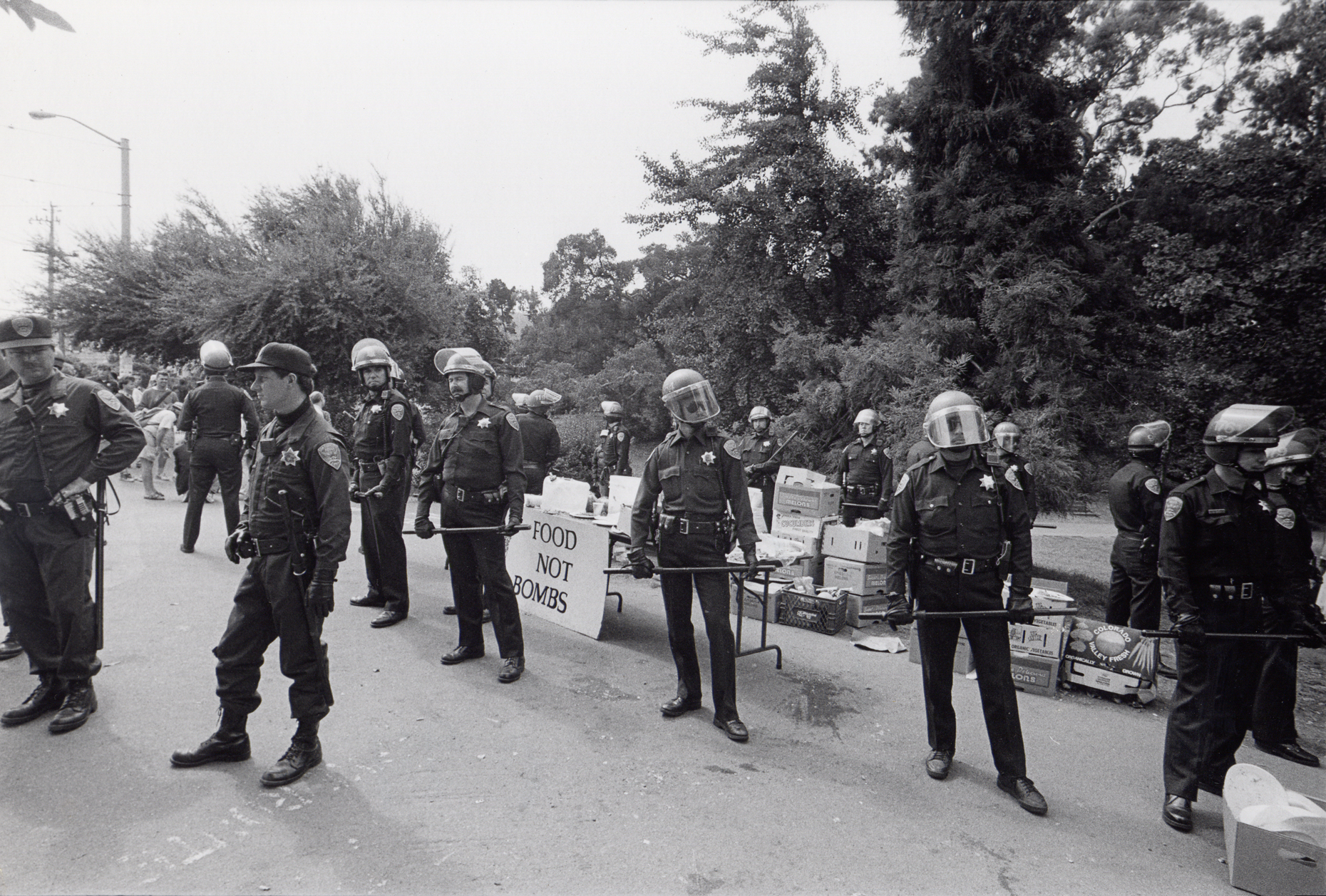
The fog was still clinging to the tree branches at the entrance to Golden Gate Park that chilly August 15, 1988, noon. John, Derek and a few others put up two heavy folding tables and set out the pots of vegan food as we had every Monday for months. A collection of Dead Heads, vehicle dwellers and park campers gathered themselves into an informal line in preparation for another Food Not Bombs lunch. John had turned up a Meat Puppet favorite on his boom box. My wife Andrea and I join the scene. I had just been released from a week in St Mary;s Hospital after my appendix ruptured.
A cluster of Haight Ashbury community members including photographer Greg Garr nervously watched and they were right to be concerned. San Francisco Police Commander Richard Holder leads a unit of riot police out of the woods and surrounds the food and literature tables. A police van wheels into position. Holder orders his men to arrest me first.
Andrea rushes along with the arresting officer frantic, “He just got out of the hospital” she screams pointing to my side. He lifts my shirt to reveal a mountain of gauze bound around my waist blurting out, “Oh fuck.”
John, Derek and six other enthusiastic food servers are cuffed and stuffed into the van with me. Deetje Boler is on hand with a tape recorder and captures the distress. “If they aren’t going to let us eat with Food Not Bombs than lets rush Cal-Foods across the street.” It doesn’t happen. Instead people chant Food Not Bombs and we prisoners sway back and forth rocking the van to our own chants. The nine of us are freed from booking at 850 Bryant about 14 hours later. The long day sitting in that dirty concrete cel didn’t dampen our enthusiasm.
These arrests were the Recreation and Parks Department’s response to our July 11, 1988, request for a permit to share our literature and food at Haight and Stanyan.
I woke the next day to news that the San Francisco Chronicle had run a page 3 top of the fold story on the arrests illustrated with a three column photo of riot police guarding our food from the hungry. That angered many who had not witness the cruelty first hand. We pulled together a meeting of community activists, agreed we would return on Monday, August 22 meeting at the Haight Street side of Buena Vista Park and march to our Golden Gate Park location. David Solnit made a flyer using the Greg Garr’s photo from the Chronicle article of the helmeted police surrounding the food and servers.
We meet at 11:30 at Central and Haight. Cases of produce lined the sidewalk. Pots of rice, beans and soup were placed on a collection of milk crates in preparation to the march. Many people arrived with pots and spoons to bang as we paraded towards Stanyan Street. Max Ventura stood on the grassy slope above the gathering crowd a sang “The World Turned Upside Down” by Leon Rosselson.
The gathered flooded Haight Street chanting Food Not Bombs, Food Not Bombs. A colorful mix of signs, banners, produce and pots of food defiantly marched towards the entrance of Golden Gate Park. The police on motorcycles made a few timid attempts to clear the street but were ignored.
We set out our gifts of lunch and produce on tarps since we had yet to recover our confiscated tables from the police. Our regulars formed a line. One by one the first twenty or so people were shared out gift of lunch. That is when the Tactical Unit of the Police stomped up and started to drag the servers off to a line of police vans parked along Waller Street. A camera man from CNN was among the journalists covering what would be another 29 arrests for sharing food without permission. Andrea and I snuck away down Waller and hide in the woods of Buena Vista Park when the police started swinging clubs. I still had a healing gash in my side and couldn’t take that risk of a beating.
The story goes global. The New York Times, Times of India, The London Times, local media and CNN reported that 24 volunteers had been arrested for feeding the hungry.
An even larger number of community members meet again a week later at Haight and Central and march down Haight to risk arrest sharing food. This time the police hesitate due to the bad publicity and they make no arrests. San Francisco Police Spokesperson Jerry Senkier tells the media that they don”t have a problem with Food Not Bombs feeding the hungry. “There has to be some kind of (police) action. At this point it seems to be a political statement on their part not a food give away issue.”
Hundreds of people showed on Labor Day to risk arrest. The riot police gave up after cuffing 59 food sharers hauling them off booking at 850 Bryant Street.
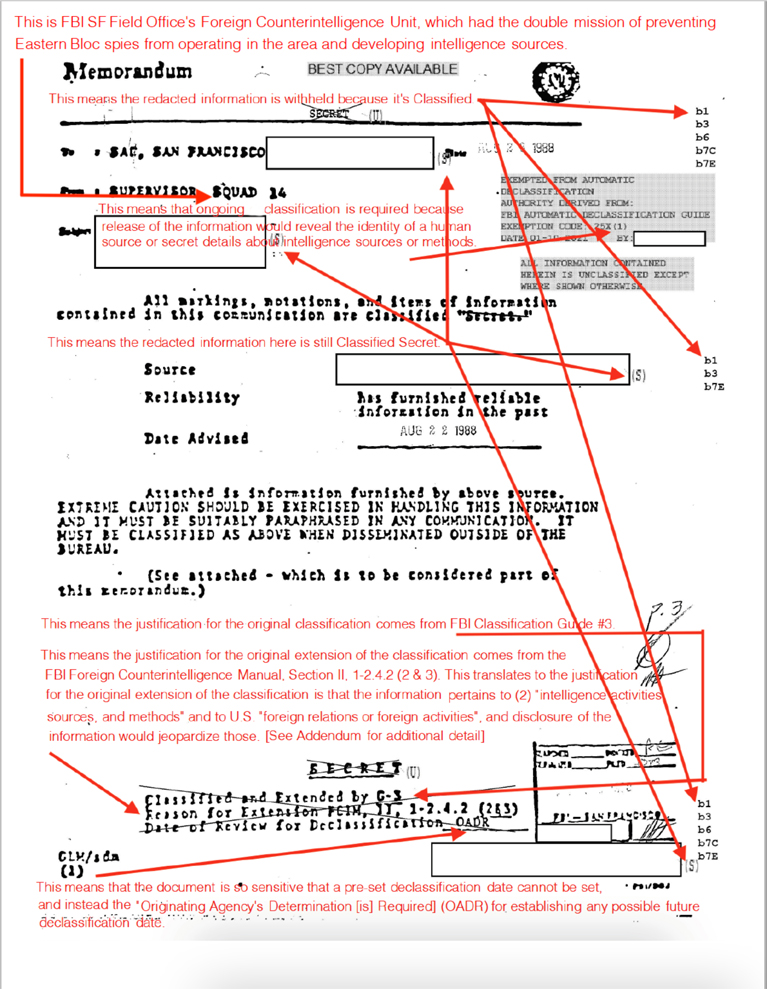
And this is were the story gets interesting. The Ryan Shapiro of Property of the People texted me this July 2021 to say they had received another batch of FBI Joint Terrorism Task Forced documents about investigations into Food Not Bombs. One was a report to the San Francisco Field Office of the FBI dated August 29, 1988, that refers to “Date Advised” August 22, 1988. Much of this document is still classified secret but there is enough information to let us know that a reliable source from Squad 14, The FBI’s San Francisco Field Office’s Foreign Counterintelligence Unit had furnished information claiming Food Not Bombs was a “National Security Threat” (b1). This person’s identity and the details of his or her report still remain classified “Secret”. What is in those other pages that would justify our being a national security threat at a time when there were not more than 20 Food Not Bombs volunteers total that were sharing vegan meals in just three cities, San Francisco, Boston and Long Beach.
Some of our volunteers and supporters joined their families and friends for the Thanksgiving Holiday. When they returned to San Francisco they mentioned that National Guard personnel had approached them as they waited for their flight home on seeing a Food Not Bombs button pinned to they’re clothing to say they had just taken a class on domestic terrorism that featured Food Not Bombs saying “Food Not Bombs is one of American’s Most Hardcore Terrorist groups.”
The Food Terrorist Diaries
August 19, 2021
This is the most recent draft of the last chapter of The Food Terrorist Diaries, a book that I am currently writing.

Chapter 61 – THAT PHONE CALL
The phone rings at 9:30 pm. I’ve stopped answering the late-night calls. A gift to myself after my second back surgery in six months.
But I look at the smart phone. UNLISTED NUMBER. Unlisted numbers are never worth answering yet I don’t know why but I take the call.
“I’m in Central Asia you understand” the man starts in a shaky voice. No hello, no I am so and so, just an announcement that the American sounding caller has dialed the Food Not Bombs phone from Asia.
“You see,” he continues without a pause, “things are really bad”.
He asks why Americans are not in the streets protesting the wars.
He tells me Americans don’t know whats going on in Central Asia.
Afghanistan I ask.
It didn’t seem like he wanted to say but yes, Afghanistan he admits.
I can tell from his voice that he is really upset.
“People don’t understand. Last week I checked into a hotel and paid for three nights telling the manager not to bother me. You can get Fentanyl real cheap here. We get it from China,” he adds. “So I took so much I was sure I would die but I woke up 36 hours later.”
He asked if I knew what a stop loss was. I told him I did, one military redeployment after another.
“I have been in Iraq or Afghanistan for the last 13 years and I just can’t take it any more.”
I asked if he talked with his superior officer. He had and was told to suck it up.
He went on to say, “I’m trying to stop drinking.”
He continued in his shaky voice, “I was in a convoy and a kid on a scooter came near us. You know kids on scooters could have a bomb so I shot him but he didn’t have a bomb.”
His voice cracked, “I killed an innocent child for no reason. If the US wasn’t here we wouldn’t be killing kids like him.”
He asks again, “ How come there are no mass protests against the wars?”
I agree we need to organize against the wars but its difficult. Trump is giving Americans lots to protest but so far war is low on the list even with his threats against Little Rocket Man.
My caller continues, “I’m not worried about nuclear war so much as the wars we already have.”
I asked if he had talked with his unit’s chaplain. He tells me he is not religious. I suggest maybe he could start a Food Not Bombs group in Afghanistan since he had mentioned that he volunteered with a local chapter before signing up for the military horrified by the World Trade Center attacks.
He thought that wouldn’t be a good idea. “Remember the US dropped orange packets of food for a while during the beginning of the war on Afghanistan than dropped orange cluster bombs that looked like the food drops. No one would trust me here and I don’t blame them.”
He tells me he logs on to Indymedia and follows Food Not Bombs on line hoping to see a mass uprising against the wars.
The compassion that inspired him to volunteer with Food Not Bombs as a teenager was the compassion that inspired him to join the military.
“Thanks for speaking with me. I am going to get drunk.”
If you want to be one of the first to learn about the publication of my next book, The Food Terrorist Diaries please sign up here:
A VICTORY FOR CHAOS AND CRUELTY
May 12, 2021
THE LOGIC OF INTERNMENT ADVANCED AGAINST THE UNHOUSED
We can only hope that the celluloid avatars at the Santa Cruz City Council are clueless, otherwise their “Camping Services and Standards Ordinance” is just naked sadism.
Imagine a fleet of city trucks and vans scouring the city every morning collecting the tents and other survival gear from hundreds of unhoused people then returning that evening after 8:00 pm to deliver everyone’s equipment so they can get a night’s rest.
That is just one of the many dehumanizing insults of the “Camping Services and Standards Ordinance” passed on May 11, 2021, in Santa Cruz, California.
Another insult features the exciting prospect of a “safe sleeping site” for 150 people when it is likely that many additional people will be finding themselves homeless on the streets of Santa Cruz every month for the foreseeable future.
“As a grant writer, I know what it takes to be competitive as a community. Funders want to see communities that are in action. Funders want to see that we are capable of moving forward with solutions, and so this is a step in that direction,” Councilmember Shebreh Kalantari-Johnson said. “And so when the state sees that we have made progress, and we have stood up 150 safe sleeping sites in a matter of months, they’re going to want to fund us because they’re going to want to see our efforts progress and expand.”
Then consider what happens with all this promised funding announced by Governor Gavin Newsom in his rule by headline desperation that seems to be exciting councilperson Kalantari-Johnson.
The Jeff Bezos “The Day 1 Families Fund” donated $2.5 million to Housing Matters in 2020 and a couple of months later the 30-bed homeless shelter at Housing Matters on River Street closed due to lack of funding. Social workers at the shelter struggled to find new locations for the dispossessed. Consider the success of Operation Roomkey. San Francisco is paying $16.1 million to shelter homeless people in 262 tents placed in empty lots around the city. They could have placed those people at the Fairmont for that price and that is really the solution here in Santa Cruz. Start by filling the Hampton Inn on Mission Street.
By dehumanizing those who cannot afford housing city officials have guaranteed that there will not be a single location for even one of their 150 person safe sleeping sites let alone the fifteen such cruel insults to human dignity that would be required to accommodate all those outside.
The May 7th Santa Cruz Sentinel article “Eviction of Highway 1, 9 unhoused residents to start Monday” quotes city and county officials as saying that the city shelter programs don’t have a great deal of capacity”.
According to Jason Hoppin, Santa Cruz County communications manager, there are currently more than 800 people staying in various shelter types. That includes COVID-19 state-funded Project Roomkey, where motels are rented out to unhoused people who are at greater risk of the virus, as well as semi-congregate shelters at Veteran’s Halls, and the National Guard Armory shelter.
“We don’t have really a great deal of capacity in that system, and we still have hundreds and hundreds of people on waiting lists to get in to that system,” Hoppin said.
Those accepted into various shelter programs are prioritized based on medical need, Hoppin explained.
“There’s not enough shelter in the county, and the city is doing the very best we can with the resources we have available, within its purview — like the Benchlands, where we have 120 people camping,” City Communications Manager Elizabeth Smith said.”
I visited the Benchlands during the afternoon of the May 11th City Council meeting. I found a friend of mine standing under the pedestrian bridge looking exhausted still grasping her neatly packed garden wagon. “How are you doing?” I asked. “Not too good” she responded. She had lost much of her items during the Highway 1 sweep and was seeking someplace to set up her tent. I counted 184 tents already pitch on the Benchlands at 3:00 pm that day. Those numbers are sure to grow well beyond the 122 spaces ordered by Magistrate Judge Susan Van Keulen.
A city that can embrace the idea of Seabright Strong is rushing ever closer to a time when the logic of internment becomes reality.
DON’T BE FOOLED BY THE WITHDRAWAL OF THE TOLO
April 14, 2021
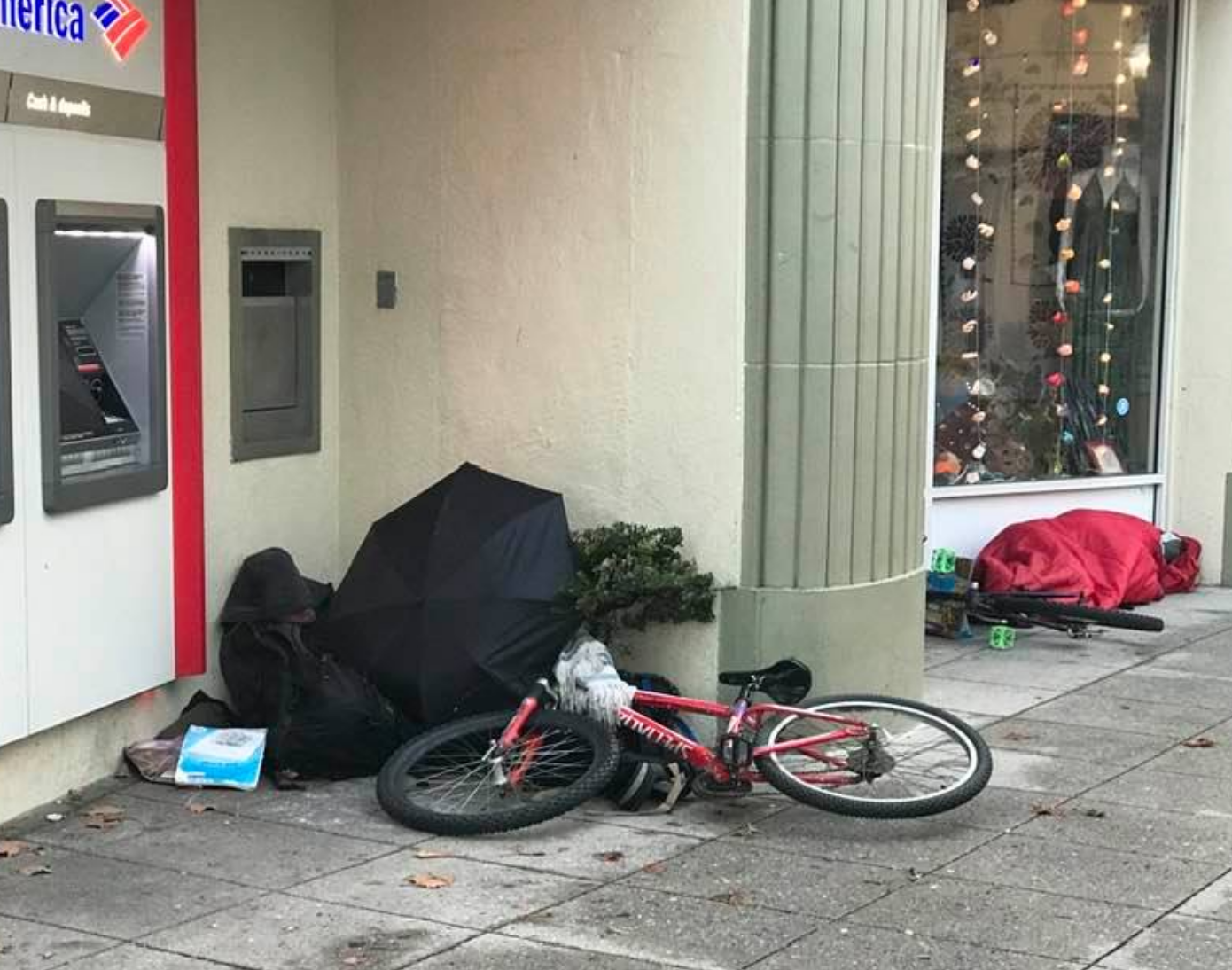
The proposed Temporary Outdoor Living Ordinance was intentionally designed to fail with the goal of encouraging an even more anti-homeless law which is set to be introduced at the May 11 Santa Cruz City Council meeting. The withdrawal of the ordinance was not a victory for the unhoused and their allies. It’s a clear win for the property speculators and their employees at City Hall.
It has been obvious from the beginning that “legalizing” camping on sidewalks outside business and in industrial areas of Seabright from eight to eight was intended to build opposition to any humane ordinance directed at the unhoused community.
Lookout reporter Isabella Cueto suggests, “Tuesday’s meeting was intended to be an opportunity for the Council to approve amendments to the law. But instead became a discussion about a complete overhaul — and a commitment by city leaders to be more transparent with the public when crafting future policies.”
City staff had over a year to reshape Police Chief Andy Mills pre-pandemic proposal to criminalize the unhoused. This “commitment by city leaders to be more transparent with the public” is an important part of the spin.
Santa Cruz Neighbors and members of Take Back Santa Cruz are seamlessly integrated into the police and city staff and participated in the formulation of this ordinance.
The January 16, 2020, Santa Cruz Sentinel article reported, “Prominent among the ideas that Santa Cruz Police Chief Andy Mills plans to shop around the community, including the more than 50 people gathered Wednesday night at a Santa Cruz Neighbors meeting, is a revamped city no-camping ordinance.”
“Mills said he was seeking input on the rough-draft ordinance ideas before bringing formal proposals to the Santa Cruz City Council for consideration. He added that he planned to announce some four or five additional community input meeting dates for March.”
It goes on to say, “The city’s Community Advisory Committee on Homelessness also has been seeking public engagement on a revised ordinance recommendation, due for city consideration Feb. 25.” I attended nearly every one of their meetings and the ideas of those supporting the unhoused was ignored and often silenced.
The January 2020 article continues, “Let me emphasize it one more time: This is not going to solve any homeless problems,” Mills told an audience of housed residents and homelessness-issues advocates alike. “The purpose is to control behaviors that affect our businesses, that affect our community, that affect our citizens – both housed and unhoused.”
Kara Guzman of Santa Cruz Local reported on April 10, 2019, “The closure of the Ross homeless camp has been delayed yet again by the Santa Cruz City Council. At Tuesday night’s meeting, the council canceled the April 17 closure and declined to set a new date. The council also formally threw out the idea of creating a new homeless camp by Depot Park. And to the relief of many residents, the council paused its search for homeless camps in city neighborhoods or parks.” That May the City Council voted to sweep Ross Camp and formed the Community Advisory Committee on Homelessness.
In 2016, Santa Cruz City Council voted to continue the sleeping ban and formed the “Homelessness Coordinating Committee Santa Cruz City Council Subcommittee” who issued their “Final Report and Recommendations” on May 9, 2017. It was nearly the same report issued by the council on May 2, 2000.
Let’s not be fooled. The ordinance was not withdrawn because it was too cruel. It was delayed because it was not inhumane enough. This continues my contention that the plan is and has been to drive the unhoused from the city and provide cover for their effort to skirt the Ninth Circuit Court ruling against cruel and unusual punishment in Martin v Boise.
With the expected increase of people being forced to live outside the obvious solution is to provide real housing, filling vacant hotels and apartment units with the people already suffering under the campaign of city sponsored terror and prepare to house the 100 to 200 additional people made homeless each month as America suffers a tidal wave of evictions.
MEETING TO ORGANIZE FOR SOLUTIONS AND RESIST THE NEW TOLO
Friday, April, 16, 2021
5:00 pm
Outside the Little Red Church at Cedar and Lincoln
LUXURY CONDOS FOR NO ONE
April 7, 2021
Hundreds more people are expected to find themselves living outside in Santa Cruz in coming months.
by Keith McHenry
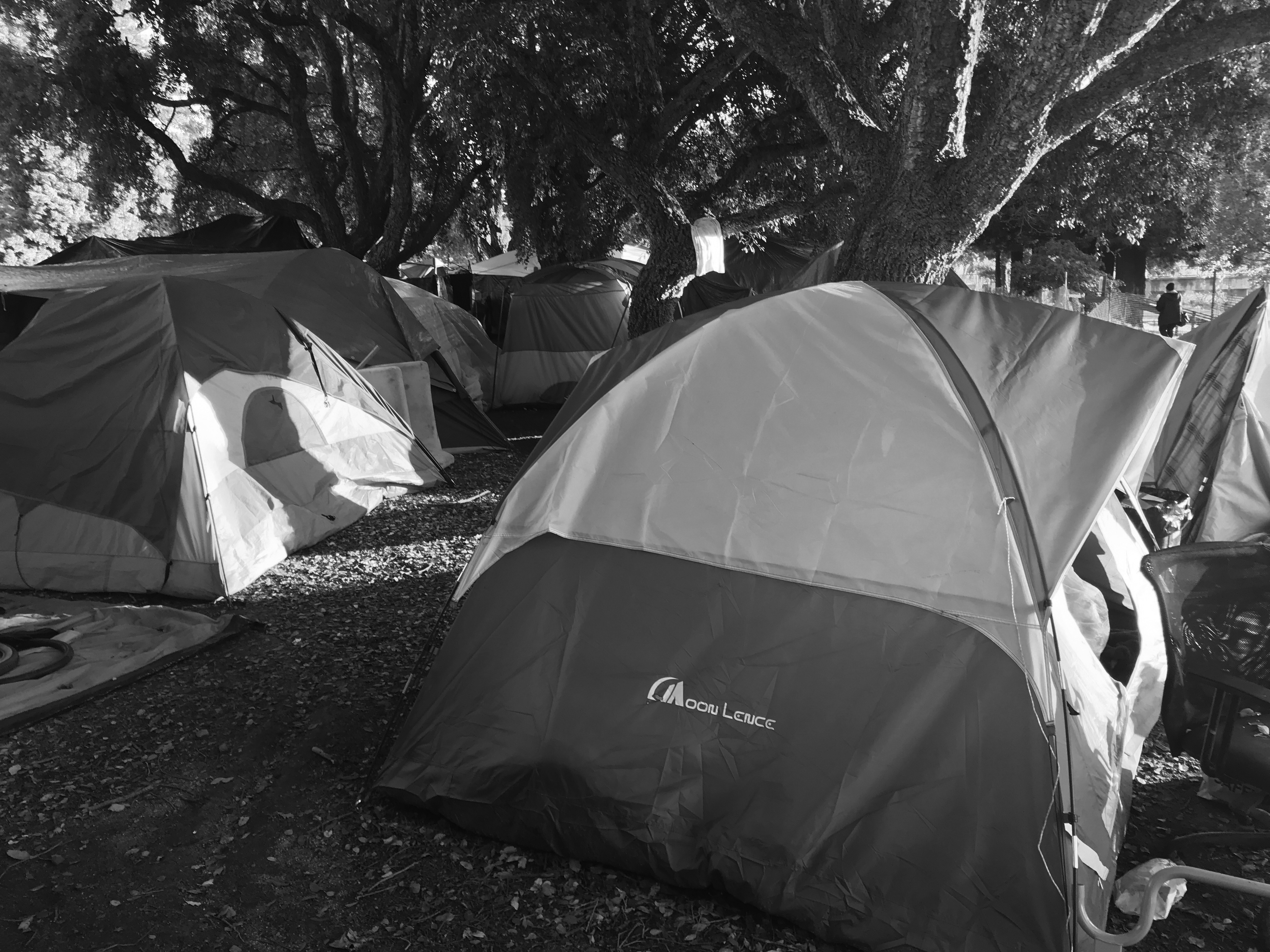
Santa Cruz City and County officials are struggling to find a legal means to remove the unhoused from sight while not offending their liberal base at the same time. In an attempt to circumvent the Ninth Circuit Court of Appeals ruling that sweeps are an unconstitutional violation of the Eighth amendment protections against cruel and unusual punishment they have spent the last year formulating their “Temporary Outdoor Living Ordinance” (TOLO) set to be revisited by City Council on Tuesday, April 13. As it currently stands people can set up a tent, tarps, blankets and other survival gear from the hours of 8 pm to 8 am on the sidewalks of Mission, Ocean, Water and Soquel Streets and in industrial areas of Seabright, Harvey West and Mission extension.
Using the same ploy that the City Manager used to mobilize West Side opposition against any humane solution, tagging Drew Glover with a Depot Park Safe Sleeping Zone, they have mobilized the East side against their already cruel ordinance.
It is not clear yet what the city and county plan to do as hundreds of people a month find themselves living outside. Local shelters are closing and people will soon be forced from the few provided hotels, sending several hundred into the doorways and along the highways. The city also plans to sweep San Lorenzo Park including the Benchlands temporary managed camp as soon as the COVID emergency is over. Newsom says that will be in June.
In the April 5th article in Lookout, “COVID-spawned budget woes will force shutdown of River Street homeless shelter next month” county supervisor Coonerty expresses, “the bigger issue the county will have to solve soon is what to do with hundreds of people in shelters that were expanded during the pandemic — but where federal funding is expected to wind down as the virus-induced crisis begins to ebb this summer and fall”.
“I think we have 650 people in shelter for COVID, mostly in motels and others, and you know that funding is disappearing and so in terms of what we’re worried about that continues to be the major issue,” he said.
Adding to the crisis resulting from an end to these marginal accommodations for those unhoused the moratoriums on evictions will end soon causing millions of Americans into cramped apartments doubling up with family and friends or even more likely, out into the streets seeking shelter in cars or tents. So far there is no plan to pay the back rent or mortgages of nearly 40 million families. That $1,400 check if it ever arrives will do little to slow this crisis. Money allocated for rent assistance has been difficult or impossible for many to access.
If local officials have any plan at all I worry that it includes shipping everyone to a large managed camp in an unincorporated area of the county.
An October 10, 2020, article in the Sentinel says “Vice Mayor Donna Meyers, however, called Santa Cruz’s situation “dire,” citing the concentration of 53% of the county’s homeless services located in a city with 23% of the county population. City Manager Martín Bernal, citing the armory shelter, the county’s Emeline Center complex and the city’s largest homeless shelter at Housing Matters on Coral Street, said community members are concerned, asking that future resources be located elsewhere in the county.”
When Fred Keeley was facilitator of the city’s “Community Advisory Committee on Homelessness” he asked several of us if we supported a mega Navigation Center, “five or six times larger” than the current Housing Matters site.
THE EVICTION CRISIS
NPR reports on April, 7, 2021, ”We’ve had a failure of leadership that’s going to result in tens of thousands, if not hundreds of thousands, of Texans becoming homeless in relatively short order,” says Mark Melton, who heads up a pro bono team of 175 volunteer lawyers in Dallas.”
“On paper, landlords could still face hefty fines and jail time for violating the CDC rules on evictions. But Melton says in reality there has been virtually no enforcement for landlords who violate the CDC order. He expects a significant number of landlords will now push ahead with evictions.”
“I think we just stepped off a cliff that we really didn’t want to step off,” Melton says.”
As is the case in most states rental assistance is difficult if not impossible to get in South Carolina. Rebecca Liebson writes in the State, “Since the moratorium went into effect, according to court records at least 50,000 evictions have been filed across five of the state’s most populous counties — Richland, Lexington, Horry, Greenville and Charleston.”
“Though there’s no way to tell how many of those tenants will ultimately be forced to vacate their homes, date from the Census Bureau shows that many South Carolinians have serious concerns about losing housing. Nearly 53% of renters said they were very likely or somewhat likely to be forced to leave home due to eviction in the next two months.”
Six people came to me in March and were seeking a safe place to sleep in their car. Sadly like most people they do not qualify for the City’s Safe Parking Program and are likely to have their vehicles confiscated under the crush of tickets they are now being issued.
The Biden administration has not announced the cancellation of rents and mortgages nor are they offering to issue $20,000 checks to everyone who has not been able to pay their housing costs during the past year.
The Eviction Lab at Princeton is warning that as many as 40 million Americans are facing eviction. At the same time a luxury condominium building boom is underway. Poor people are being “Red Lined” from their communities and are forced to seek shelter under bridges, doorways on along highways.
Tragically everyone could be housed. Bay Area business journalist Aaron Glantz’ book “Homewreckers” about the 2007 housing foreclosure crisis he provides evidence that property speculators had a strategy that included parking their money in housing that they intended to leave empty. The current wave of building here in Santa Cruz is also likely to sit vacant. The Pacific and Laurel property was already sold to another out of town investor before any construction had begun.
AMERICA’S VERSON OF GERMANY’S “USELESS EATERS”
I was first confronted by the now common use of language to justify the elimination of the homeless in the fall of 1986 in Massachusetts.
I had a graphic design business in Kenmore Square, Boston and lived in an apartment across the street from my office. The Boston Red Sox were among my Kenmore Square clients. I also volunteered my services to the Kenmore Association, a local civic group organized by local property speculators where they called the people who lived outside in our neighborhood, tramps, vagrants, punks, druggies, transients, vermin, and streetpeople.
The October 1986 issue of the association’s newsletter included this:
KENMORE NEWS
“The Security & Maintenance Committee encourages all KA Members to assume an active role in cleaning up Kenmore Square. In order to prevent the attraction of streetpeople (especially the “rough element”, new to Kenmore Square), following guidelines were suggested at the breakfast meeting…
“Please don’t give free food to these streetpeople.
“Please lock all dumpsters. Unlocked dumpsters will be cited by the City inspectors and all infractions will be subject to fines. Open dumpsters attract street people looking for collectibles and food.
“Please refrain from throwing returnable cans and bottles in public trash receptacles. The streetpeople find Kenmore Square a profitable location for collecting on these cans and bottles.”
“Start calling the police if certain annoyances persist and keep a record of your calls (ie. date, time of day and response time).”
OUR RESPONSE
My wife and I were shocked and responded to the association.
“As members of the Kenmore Association we object to the dehumanizing statements against those living on our streets made by the Security & Maintenance Committee in the October newsletter.”
“These people are our neighbors, friends and family and deserve our compassion and support.”
“Dehumanizing people in this manor smacks of Hitler’s Germany. The association is showing a total disregard for people being people. We urge the Association to support efforts to help our neighbors instead of adopting policing to drive them out of the community.”
“There is no evidence that their presence is having any impact on business. We should celebrate the unique qualities of Kenmore Square that make it attractive instead of seeking to become a second Newbury Street.”
“Sincerely
Andrea and Keith McHenry
24 hour residents of Kenmore Square”
FEMA CAMPS?
The decades long drum beat of dehumanization maybe coming to its logical conclusion.
The time is coming where we are either going to turn our gaze away from the inhumane policies of the property speculators and their employees in government or we are going to unite against these plans to drive the unhoused into camps.
Three decades of the dehumanization of those who cannot afford rent has set the foundation for forced removal of America’s “Useless Eaters.”
We better act now or as the poem of from German Lutheran pastor Martin Niemöller,
“First they came for the homeless, and I did not speak out —
Because I was not homeless.
Then they came for the Mexicans, and I did not speak out —
Because I was not a Mexican.
Then they came for the Muslims, and I did not speak out —
Because I was not a Muslim.
Then they came for me —
and there was no one left to speak for me.
WHEN AMERICA LIVED IN HOUSES INSTEAD OF TENTS
March 19, 2021
The first Food Not Bombs soup line – March 26, 1981
The founders of Food Not Bombs spent the evening of March 25, 1981, busy preparing a 60 quart pot of soup and other goodies for the next day’s street theater outside the stockholders meeting of the Bank of Boston.
Ronald Reagan just took office promising his Trickle Down economic theory and a ratcheting up of America’s nuclear deterrent. The board of directors of the bank also sat on the boards of Raytheon and other nuclear industry heavy weights. They had invested in our target, the Seabrook Nuclear Power Station, a project that local activists like ourselves had been attempting to stop.
Our plan was to dress as Depression era hobos, set up a soup line and hand out literature warning that if the policies of the bank and those of Reagan were to be implemented people would find themselves seeking meals at a soup kitchen. Our young enthusiastic crew wanted to shock and believed the sight of people lining up to eat outside the Federal Reserve Bank might jolt some people into action.
But as we prepared our vegan stew we became concerned that we had not done enough outreach to have a line of faux hobos necessary for the intended impact. We also had a lot of food and didn’t want to waste it so two of us went to the only homeless shelter in Boston late that evening.
I knocked on the door of the Pine Street Inn a little after mid-night. The manager welcomed us in when we explained our intentions. He lead us to a room where twenty or thirty men sat on the tile benches or laid out on the floor. I explained the purpose of the action. One guy noted with excitement that it reminded him of the protests in the sixties. His bench mate added his support assuring us he would participate.
Sure enough the men arrived outside the Federal Reserve Bank the next day at noon. A business man walked up to me shocked that it had only taken a couple months of Reaganomics before the poverty of his policies had resulted in the need for food lines. “You are likely to see a lot more hunger if we don’t start organizing now,” I responded. Some of those attending the stockholders meeting cursed us but one blue haired lady gave us the thumbs up. “Yes, these guys are crooks and I plan to vote against their proxy,” she smiled.
I remember that first man who reached out to receive his bowl of soup. “God bless you,” he quietly prayed as his eyes lit up with gratitude, “you should do this everyday. There is no food for us here in Boston.”
So that evening as we cleaned up from our first soup line we agreed to quit our jobs and spend our days recovering food that we would deliver to housing projects and share meals with the public at Harvard Square or Park Street Station.
Forty years later I have to remind people that there were no tent cities and we only saw an occasional unhoused person. There was that lady bound in black garbage bags who propped her self on the stairs of the building next to the symphony and the huddle of men who sat in a dark ally near the Naked Eye. We had a system that provided housing, affordable education and wages while meager still made it possible to rent an apartment.
Fast forward to today.The governments and their corporate sponsors left Americans to fend for themselves as the Congress showered wealthiest one percent with trillions of our tax dollars.
The total corporate capture of society was ushered in with the inauguration of the new administration. Americans are embracing the censorship of an army of disinformation specialists funded by the military and social media titans. We are repeatedly told the $1,400 check and child tax credit will lift us out of poverty. Critics are de-platformed, fired and ridiculed. A sea of cheery propaganda insults those struggling to survive and mocks those pointing out the obvious fact that no one can pay twelve months rent with a child tax credit and their stimulus check. Its become rule by headline. The fear of Trump, COVID and poverty has Americans celebrating the implementation of the corporate police state.
Millions of Americans are facing eviction as hedge funds and shell companies rush to park their billions in luxury condominiums developments that are unlikely and not intended to be occupied. Families selling their homes are finding it impossible to buy another house because deep pocket investment companies are always able to out bid them. Property speculators are scooping up the failed businesses. Millions of Americans had already been forced live on our streets, in our parks, hotels, cars and couches before the pandemic. Empty apartment units still outnumber the unhoused even as the numbers of people find themselves dumped on to the streets.
Even though soup lines have become common place there is hope in the memory of a time before people lived in tents. But under the current clampdown on ideas and expropriation of resources this will be challenging. This is where Food Not Bombs and our allies can make a difference. Since we are not welcome in the advancing global economic paradigm it is up to us to create our own society outside their walls.
THE NEW WAR AGAINST AMERICA’S HOMELESS – Political recalls and the campaign to dehumanize those who live without housing
July 15, 2019
Millions of America’s 140 million poor are already living without housing and many of us are a medical crisis, layoff or car repair away from joining the ranks our country’s unhoused. Cities across America are increasing their sweeping of camps, discarding people’s tents, blankets, and other survival property. At the same time economist are warning that there could be a global recession as a result of a number of issues including the trade wars, tax breaks for the super-wealthy, and the student loan debt. There is a potential catastrophic increase in the number of America’s being forced to live on our streets.
This impending crisis could be one reason for the new attacks against those living outside. An ideological war that attempts to paint the homeless as mentally ill drug addicts beyond help or redemption and is driving a wave of Recall Campaigns against political leaders who have attempted to introduce humane solutions for the growing homeless crisis.
The Discovery Institute’s Center on Wealth, Poverty, & Morality is initiating a campaign suggesting that there are scholarly arguments against solving the crisis with the construction of shelters and affordable housing claiming the homeless are mentally ill drug addicts who will never have the resources to rent housing so there is no reason to build it. “An Addiction Crisis Disguised as a Housing Crisis”
The new campaign is even more disturbing than the Manhattan Institute’s first anti-homeless attacks which included a vigorous promotion of the Broken Window Theory and a call to pass Quality of Life Laws like those against sitting on commercial streets, so-called aggressive panhandling and public sleeping that justified the municipal criminalization those without housing in the mid-eighties. The homeless were to blame for our economic problems “because no one will go downtown and shop anymore”.
The Discovery Institute’s June 2019 essay in the Manhattan Institute’s City Journal “An Addiction Crisis Disguised as a Housing Crisis” by Christopher F. Rufo suggests that there is a scholarly argument against claims that high rents, low wages or other economic policies have anything to do with the increase in those living without housing.
Rufo ends “No matter how much local governments pour into affordable-housing projects, homeless opioid addicts—nearly all unemployed—will never be able to afford the rent inexpensive West Coast cities. The first step in solving these intractable issues is to address the real problem: addiction is the common denominator for most of the homeless and must be confronted honestly if we have any hope of solving it.
Sinclair Broadcasting’s hate film Seattle Dying is the first shot in this new well-financed and nationally coordinated effort to dehumanize the homeless.
Former Democratic California State Assembly Person Mike Gatto had advanced this theory in a June 2019 OpEd in the San Jose Mercury News, “So if economics aren’t the issue, what is? Two things. About 40 percent of homeless are addicts and another 25 percent have severe mental illness. In other words, over two-thirds of the homeless suffer afflictions that diminish rational behavior.”
Another disturbing development is the use of the recall process against politicians who advance solutions to the homeless crisis as is the case in Chico, Santa Cruz, and Los Angeles.
Alexandra Datig creator of the Front Page Index whose tagline is “God, Country, Liberty, Freedom” introduced a “Petition to recall Los Angeles Mayor Eric Garcetti for the homelessness crisis plaguing the city,” claiming that they are responding to the June 4, 2019, report of a 16% increase in the number of homeless in the county.
The petition claims “Mayor Garcetti’s inaction and lack of prioritization for the citizens of Los Angeles has caused third-world conditions, with disease breeding devastation on the homeless of Los Angeles who are forced to live in conditions that are a danger to all of the public health.”
Another group hostile to the homeless calling themselves One Chico launched a recall campaign in May 2019 to unseat Mayor Randall Stone and Councilman Karl Ory. Two of their main justification for the recall is the “Inability to uphold Chico’s mission to make Chico a safeplace to raise a family, an ideal location for business and a premier place to live.” and, “Promotes failed homeless solutions that attract and coddle criminals.” The members of One Chico, Nichole Nava, Jaime Jin, Kim Burke and Tim Lynch supported a tough sit-lie law against those without housing and organized to block a shelter on Orange Street.
A coalition of anti-homeless hate groups dubbed Santa Cruz United filed a petition in June 2019 to remove Council members Drew Glover and Chris Krohn they “repeatedly voted against closing the Ross Camp, while falling to pursue legal, realistic, and humane solutions to homelessness in the City of Santa Cruz. By opposing the closure of the Ross Camp, he (they) contradicted the recommendations of Fire Chief Hajduk and County Health Officer Leff, and endangered the health and safety of Santa Cruz residents, both housed and unhoused.”
Members of Santa Cruz United have remained silent about threats and claims of violence against those living outside on their social media platforms. They have also championed sit-lie laws, the continued ban on sleeping outside at night and blocked efforts at the creation of shelters and addiction services. This group includes Pamela Comstock, Analicia Cube, of Take Back Santa Cruz, Deborah Elston, President of Santa Cruz Neighbors, and Kevin Vogel, Former Police Chief City of Santa Cruz.
All three recall campaigns use the fear of the homeless spreading disease and lawlessness. None of the politicians facing recall have been accused of anything but voting to support realistic solutions to address the growing crisis of families living unhoused.
Trump’s favorite TV Stations is participating in the dehumanization of those without housing now that it has successfully sowed fear of the refugee to millions of Americans. Are those frightening pictures of standing room only fenced in immigration detention centers a means to accept camps for the millions evicted onto our streets?
Fox’s Jesse Watters comments on the increase in those living outside in Los Angeles saying “you only have one solution. You bulldoze the 50-block radius, and you institutionalize everybody and detoxify them, and then you let them out.”
The Washington Post story, “Trump paints a dark picture of homelessness in cities: ‘We may intercede’ about the July 1, 2019, Trump interview with Tucker Carlson adds a frightening voice to the war on America’s homeless.
Trump responds, “Police officers are getting sick just by walking the beat,” he claimed. “We cannot ruin our cities. And you have people that work in those cities. They work in office buildings and to get into the building, they have to walk through a scene that nobody would have believed possible three years ago.”
“We have to take the people,” he said. “And we have to do something.”
“When we have leaders of the world coming in to see the president of the United States and they’re riding down a highway, they can’t be looking at that,” he said. “They can’t be looking at scenes like you see in Los Angeles and San Francisco . . . So we’re looking at it very seriously. We may intercede. We may do something to get that whole thing cleaned up.”
The war against America’s homeless also includes a campaign to underestimate the crisis. Most reports on Trump’s comments claim that 500,000 people homeless based on federal data collected in the HUD Point in Time counts. It seems unlikely that the homeless population dropped by 250,000 people during the 2008 housing foreclosure crisis.
The National Alliance to End Homelessness website states,”The U.S. Department of Housing and Urban Development (HUD) requires that communities receiving federal funds from the McKinney-Vento Homeless Assistance Grants program conduct a count of all sheltered people in the last week of January annually. Unsheltered counts are required every other year, although most communities conduct an unsheltered count annually. In an unsheltered counting effort, outreach workers and volunteers are organized to canvas Continuums of Care to enumerate the people who appear to be living in places not meant for human habitation. The first of these counts were conducted in January 2005 meaning that we have data for every CoC for the last ten years.”
The U.S. Department of Housing and Urban Development. 2007 Annual Homeless Assessment Report to Congress, There are 750,000 Americans who are homeless on any given night, with one in five of them considered chronically homeless. The National Alliance to End Homelessness reports that 564,708 people in the U.S. are homeless in 2018.
If the history of past dehumanization campaigns against those without housing is any indication the framing of the crisis facing millions of Americans as “An Addiction Crisis Disguised as a Housing Crisis” and the use of the recall to stop political leaders from advancing realistic and humane solutions suggests a dramatic increase in the passage and enforcement of harsher laws, destruction of people’s survival property and the possibly of internment as is already the case with people fleeing the chaos and violence caused by decades of US wars in Central America.
The phrase “life unworthy of life” or “Lebensunwertes Leben” in German was a Nazi designation for the segments of the community which, according to Hitler’s regime of the time, had no right to live. We cannot let this happen here. We are homeless not helpless.
 Anarchistcook's Weblog