1,000 Days of Compassion
December 2, 2022

Santa Cruz Food Not Bombs fills the lockdown void
The streets went silent that misty March 14, 2020 morning. I passed only two other vehicles on my way to prepare the meal at the Veteran’s Hall. News that the indoor food programs had been ordered shuttered meant our unhoused friends would have to go without food if we didn’t step up and fill the void. Eight of us Food Not Bombs volunteers gathered at LuLu Carpenters that cold Saturday to discuss our plans. I think all of us were in a state of shock at the mystery that lay ahead.
A medical social worker who had just been trained in the COVID-19 safety protocols at Good Samaritans Hospital detailed what she had learned the day before. We moved our meal to the Town Clock from the Post Office so our line of guests would not be standing near the dozen or so people camping along the Water Street sidewalk.
We were honored to fill in for the weekday meals at St Francis and Louden Nelson senior lunch during the two week lockdown to flatten the curve. When they reopened we would return to our weekend schedule.
Two weeks turned to a month, then two months, then two years and on December 10, 2022, our all volunteer group will have shared hot meals, drinking water and survival gear every afternoon for 1,000 days.
The City of Santa Cruz responded to the crisis by erecting Triage Cages for the homeless in downtown parking lots while locking down everyone else. The Santa Cruz Homeless Union and Food Not Bombs responded by setting up a Covid -19 Relief Center at the Town Clock and placed 180 people in hotels for several nights. The police evicted us for the first of eight times claiming our hotel voucher distribution was an illegal gathering.
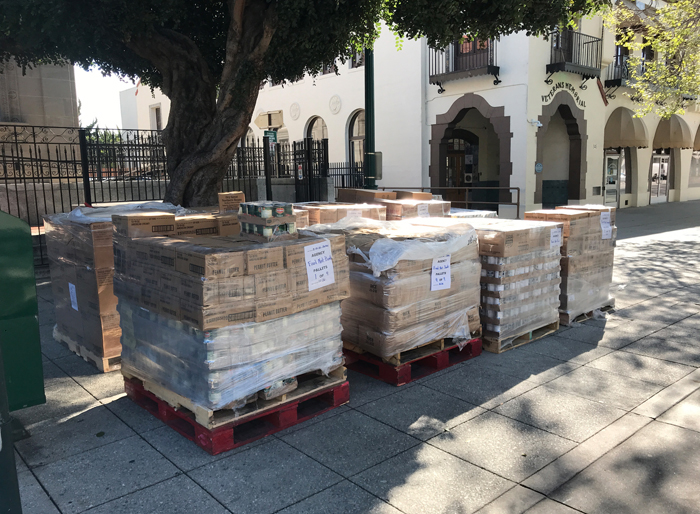
Second Harvest stepped up and started their weekly deliveries of pallet loads of dry goods. They delivered at least 20 pallets of rice, beans and other provisions during the first week of the crisis. We filled the empty offices at India Joze at 418 Front Street, a shipping container, and warehouse at Barrios Unidos. We provided groceries to the Live Oak School District and helped them acquire their own account with Second Harvest.
Our kitchen moved from the Veterans Memorial Hall to India Joze to the Little Red Church and now up to Scotts Valley. The stress of loading and unloading our van several times just to set up became too much so we bought a second shipping container and placed it at our meal next to the abandoned Taco Bell at Laurel Street and when an out of town developer threatened to seize it we moved it across Front Street to lot 27. When another out of town property speculator announced the destruction of India Joze and the other business on Front we bought a third shipping container and cleared out our supplies at the 418.

While our all-volunteer staff was scrambling to meet the needs of the ever growing number of the just evicted people we also provided food and logistical support for several Black Lives Matter marches, organized protests against the war in Ukraine and fed the strikes at the University.
The sky turned an eerie red as those fleeing the CZU Lightning Complex fire joined us at our Laurel and Front Streets meal. I remember several people coming to us desperate for a change of clothes.
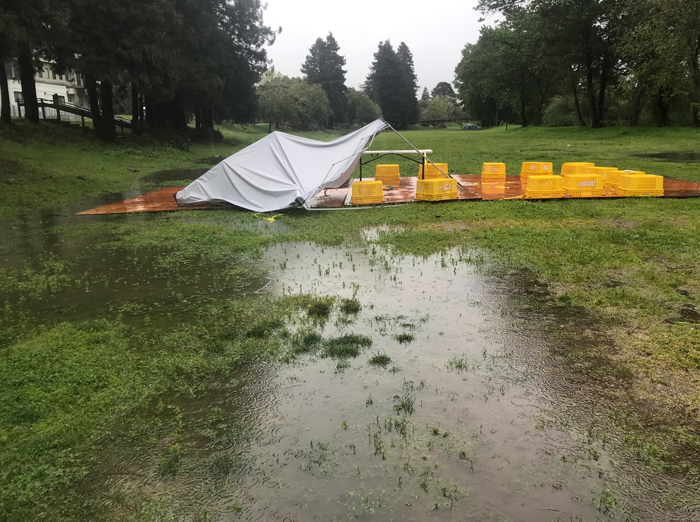
When the city forced us onto the Benchlands our equipment was flooded in two feet of water so we returned to the higher ground of Garage 10 only to be forced to Laurel and Front Streets. After we won a federal law suit stopping the eviction of those camped in San Lorenzo Park and those on the higher ground moved to the Benchlands our volunteers began our weekly delivery of a pallet or more of food to that community of hundreds every week.
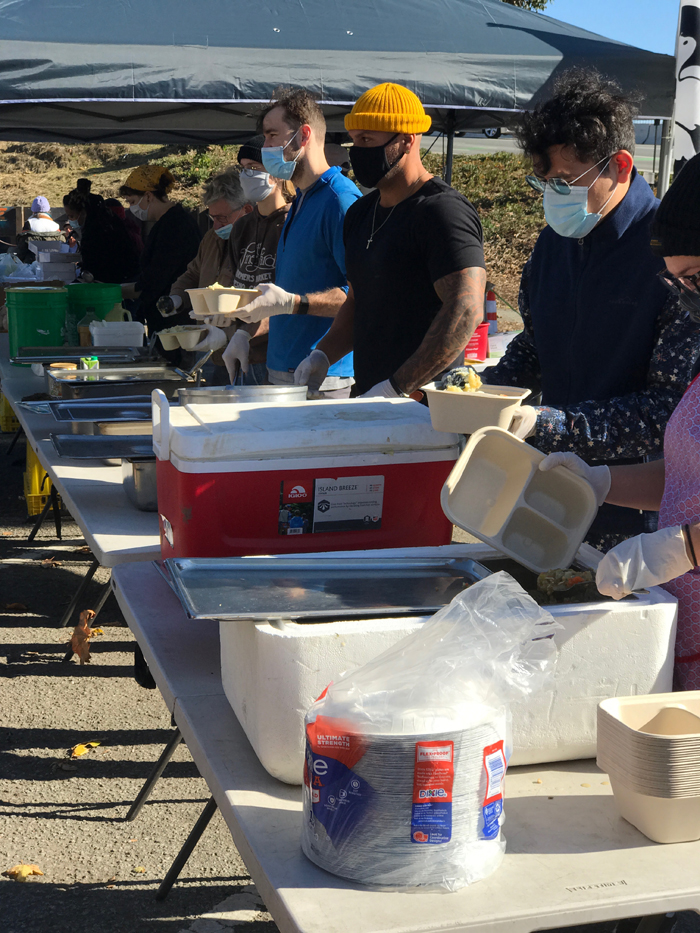
Our group had to think creatively. We first met on Zoom then in person to figure out solutions to each logistical issue and set that week’s schedule of volunteer tasks. A food recovery team picked up at farmers markets, Trader Joes, Companion and Beckmanns bakeries, and a host of other food sources. Another group shared the meal, clothing and drinking water while often having to calm people suffering from emotional crisis. We provided the only reliable hand washing station for hundreds. Others prepared the hot meals and spent hours washing pots and hotel trays. Community members graced our program with their own hot meals and survival gear donations.
We repaired vehicular homes to keep them from the city tow trucks. We reunited family members seeking their unhoused children. We comforted the stunned newly homeless and helped them with a pup tent, a warm meal and a listing of mostly closed services.
Our volunteers provided the annual Thanksgiving and Christmas community meals during the two years of restrictions. We also hosted a free concert during every holiday. We also lost many friends during these 1,000 days. Rick our Bread Man and Tree the hibiscus tea lady died early in the crisis. The death toll from the elements, murders and addiction has been horrific. We held our annual longest night of the year memorial to honor those who did not make it on the cruel streets of Santa Cruz and plan to do so again at the Town Clock this December 21st.
We will be celebrating our 1,000th day with live music. The 1,000 Dancing Doves is performing at the Clock Tower at noon on Saturday, December 10th and Folk Punk musician David Rovics will be playing a benefit concert at the Resource Center for Nonviolence on Friday, December 9th at 6:30 pm.
We have 1,000 days of filling the void left by the governments while those vultures were too busy aiding investment firms in their construction of luxury condominium projects to provide necessities to their residents.
We are practiced at responding to the impact of a failing economy. There is every indication that a Great Depression scale collapse could sweep the world in 2023 and we know city, county, state and federal officials are not about to help our community in this time of crisis. The politicians have wars to fund, metal and glass monstrosities to build, and off shore bank accounts to fill, so it will be up to all of us cooperating together to take care of the needs of our people.
Our compassion will be required to navigate the difficulties ahead. Food Not Bombs is hosting a community meeting on Sunday, January 15, 2023, at the Resource Center for Nonviolence to discuss the logistics of survival as the economy crashes and we face cuts in electricity, food shortages, the possible transition into a cashless digital security state and increase in homelessness and poverty.
If we all work together and think outside the box we can flourish. We invite you to join us.
Santa Cruz Food Not Bombs – PO Box 422, Santa Cruz, CA 95061 USA santacruz.foodnotbombs.net – 1-800-884-1136
NINE HUNDRED DAYS OF LOVE
August 29, 2022
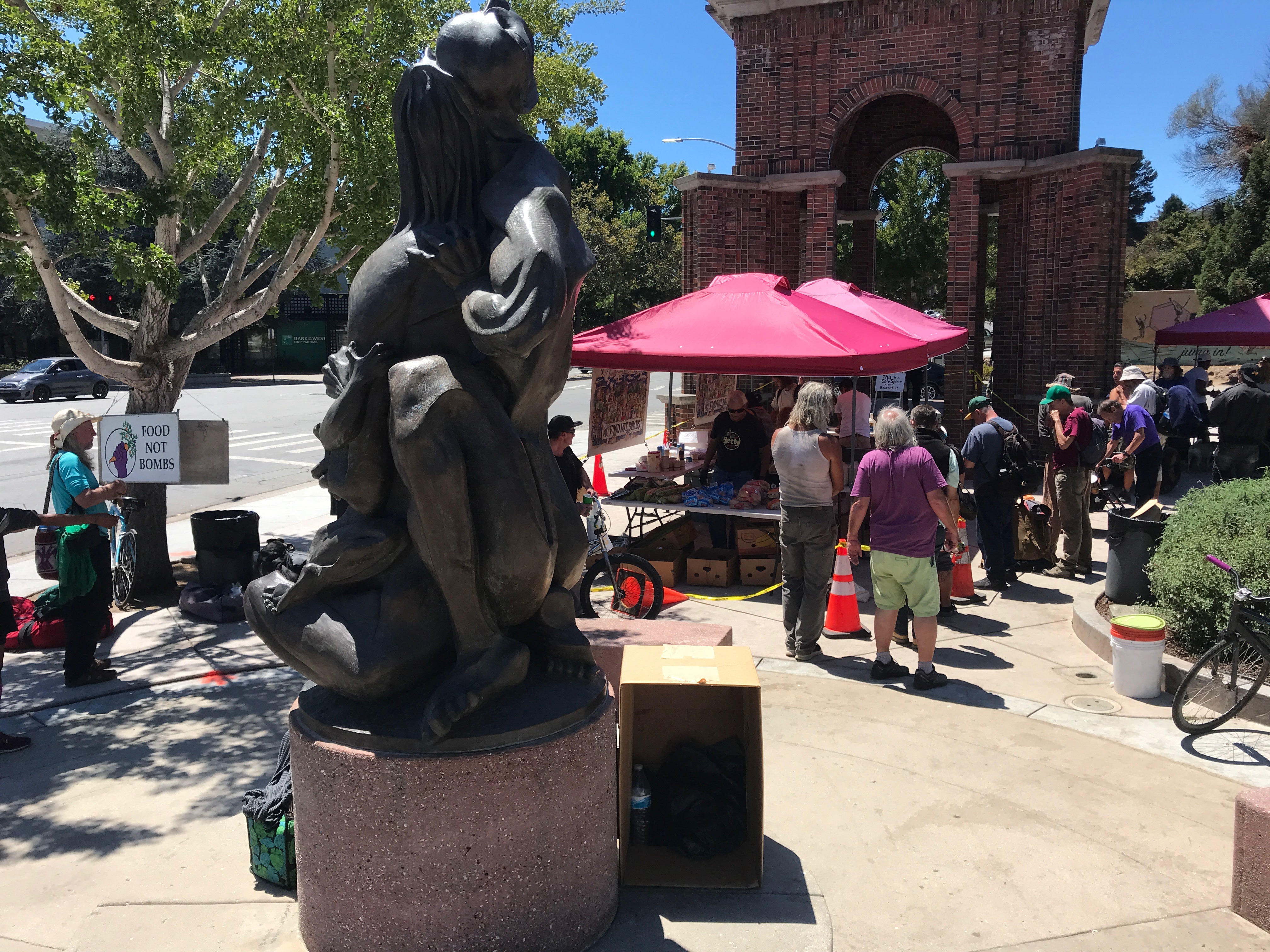
Day one of the pandemic restrictions here in Santa Cruz, California was on a misty Saturday, March 14, 2020. The indoor meals for the poor were ordered closed and access to water and toilets for those who lived outside locked.
The volunteers of Santa Cruz Food Not Bombs met at LuLu Carpenters that morning to sketch out a plan on how to respond. A health professional walked us through the COVID safety protocol she had been taught at Good Samaritan Hospital the day before. We outlined our plan. Move to the Town Clock so the usual line of 40 people would not be standing next to the people living in tents up against the Post Office fence. We planned to pass the plates down the row from gloved server to gloved server asking each person what they wanted added to their plate.
We were ready for a month long lockdown to slow the spread. Saint Francis, the senior meal at Louden Nelson and the Monday night coffee house at the Little Red Church would resume soon. We could fill the void of shuttered meal programs for a month or so at least.
It’s 900 days later and the indoor meals are still closed or restricted, no Monday night coffee house. Who would have imagined in those first days that we would have to navigate so many twists and turns in our journey to meet the needs of our community?
Preparing for the unknown is our speciality. We moved to the Town Clock and placed a distancing barrier of large yellow Trader Joe’s lugs and yellow caution tape between the serving tables and those joining us for a meal. The bleach stains on my seven black Food Not Bombs t-shirts attest to the hours spent disinfecting tables and van surfaces. The faint ghost six-foot-apart spray painted dashes marching towards our service areas are a sad reminder of those days of fear.
The only people outside were those without housing, our volunteers and the police. Traffic had vanished. I waved at drivers passing by and they waved back.
The city erected COVID triage cages on downtown parking lots to quarantine the unhoused. That cruel plan was abandoned in short order as the optics and our lack of cooperation with their plan to have Food Not Bombs lure the homeless into their inhumane scheme failed.

We unloaded dozens of pallets of dry goods donated by Second Harvest Food Bank, storing thousands of pounds of rice, beans and canned food first at Barrios Unidos and our first shipping container. We would buy two more 20 foot conex boxes in the first year of the crisis. They are also filled to the ceiling. We are getting ready for the food shortages.
We helped organize a weekly grocery distribution for the Live Oak School District even as the city was evicting us into the flooded grounds of the Benchlands, kicking us out of the Town Clock to Garage 10 on River Street, then out into the rain. Our equipment was swamped in nearly two feet deep water so we returned to the garage. They wouldn’t end their campaign of evictions until we returned to the Town Clock and ignored their efforts to drive us out of sight to the margins of our community. After all we have wars and poverty to protest and the Collateral Damage statue is the traditional public space for free speech and assembly. Our protest is daily from 12:00 noon to 3:00 pm and includes a hot full course meal, coffee, water, groceries and clothing. The theater of what is possible.
When the holidays came we helped organize that year’s Community Thanksgiving and Christmas hosting the well attended feast at Lot 27. The Vets Hall was a shelter and indoors at the Santa Cruz Museum of Art and History was out of the question according to government restrictions. We collaborated with Lee Brokaw and the Veterans for Peace, the crew at India Joze and Steve Pleich. A few dozen people from the community volunteered to help. We had piles of pies. These were beautiful days of love and joy.
We also participated in blocking the city’s 2020 Holiday Evictions of the over 100 campers trying to survive at San Lorenzo Park. We joined the Santa Cruz Homeless Union in filing a Federal Lawsuit that stopped the sweep, protecting them from facing arrest if driven to the doorways and levee banks of downtown.
A year later we provided another Thanksgiving dinner at the corner of Laurel and Front Streets and overcame huge obstacles to share the Community Christmas Dinner under the parking garage at 24 River Street during the driving rain.
Desperate fire evacuees joined us at Lot 27 under the eerie red skies, seeking food and clothing as they fled the CZU Lightning Complex Fires, many with only the clothes on their back.
We had to adjust to ever changing conditions. We scrambled for a kitchen when the Vets Hall was turned into a shelter. India Joze kitchen bridged the gap. We secured the Little Red Church until they needed to reclaim their kitchen and had to move to a commercial space in Scotts Valley.
The daily packing and unpacking of our food, hand washing station, tables and canopies requiring skill and several trips a day in our van to and from the meal. This seemed unsustainable so we bought our second shipping container and placed it at our meal. A month later a luxury condominium developer surprised us one afternoon saying he would seize our equipment and shipping container. They had escrow in the morning he pleaded. We had to call a flatbed to move it across the street from the abandoned Taco Bell to Lot 27 reclaiming the parking lot for a second time.
A late Friday afternoon call from the city manager’s office threatening to take our conex box to make room for more construction forced us to make another hasty move to the parking lots down Front Street when yet another threat by another luxury condominium developer from Sandy, Utah forced us to move to the Ron Swenson’s land near the Homeless Garden Project. But it didn’t take long for the city to kick us off his private property so we moved it and the tons of food it stores to a location out side the city limits.
In the early days the emotional stress of the unknown sparked outbursts and fights among some of the more fragile people attending our meal. There were times when it seemed someone might get beaten to death if we didn’t intervene. Just like our friends who joined us for food we never quarantined. But our shared days of misery in those first months helped strengthen our relationships and the tension and violence started to calm as people became relaxed about the pandemic’s threat.
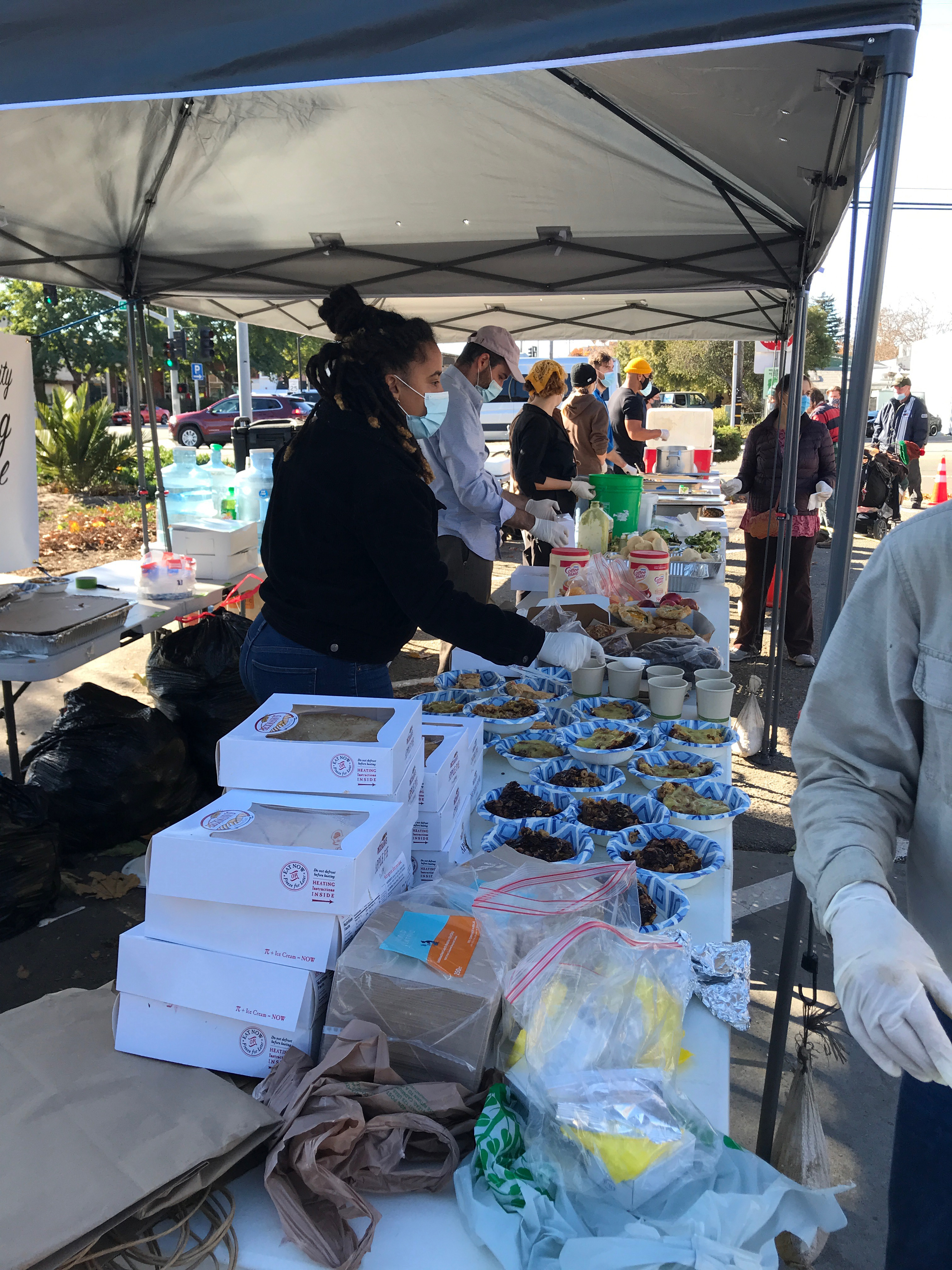
We hosted Johnny’s free solar powered concerts at every holiday and celebrated the 40th anniversary of the founding of Food Not Bombs in Lot 27 with Keith Greeninger. Live music filled the perfect May afternoon during Soupstock 2022 at the San Lorenzo Duck Pond.
The people of Santa Cruz have been generous, delivering food, clothing, survival gear and money. A group has set up an herbal tea stand at the meal. The UCSC farm drops off their fresh produce. Random student groups pass by with vegan burgers. Curtis Reliford donated bundles of clothing to the music of Ray Charles. We have been touched by so many the list would fill pages.
Our meal is often the first place the just evicted come to find services. Since the shelters are always full we try to provide them with a pup tent and offer suggestions on where to hide. To see their expression of terror at the prospects of a cold night alone on the levee is almost more than one can bear.
We are Santa Cruz intertwined with those drifting homeless on our streets and struggling to stave off eviction. We help repair vehicular homes in an attempt to keep them from being seized and junked by the city. We’ve helped connect family members. We’ve embraced those in their times of crisis and danced together in defiance of the lockdown fear that once threatened to smother hope. We fought and struggled. We laughed and loved.
We claimed our freedom from the dystopian corporate state and their celluloid avatars in local government. Predatory vultures disinterested in making necessities of life accessible to those who share our seaside community. Blind to the reality of the food riots that our meals have stopped.
Our crew of volunteers have provided healthy hot meals with about 200 people every day for 900 days. The logistics can be challenging. We developed patterns of food collection, meal preparation and service.
One team would recover food from groceries, farmers markets and bakeries. They would order two or three pallets of food from Second Harvest, storing some in our secure shipping containers, some at our kitchen and at least one pallet was delivered every week to the pantry and kitchens of the Benchlands.
Our logistics included securing pallets of donated compostable paper products from WorldCentric and buying coffee, oils and sugar from Costco. We bought propane tanks and stoves, extra canopies, kitchen equipment and a third shipping container, packing it to the ceiling with more dry goods in preparation for the expected food shortages. Volunteers work to raise money for the monthly rent of $4,100 for our commercial kitchen and hundreds of dollars in gas for our delivery vehicles. There is always the hours of paperwork and reports for insurance, Second Harvest and the Internal Revenue Service.
A sea of other essential workers kept our vehicles in working order, printed our literature and supplied us with cooking and cleaning supplies. Security guards and cashiers at New Leaf helped me load and unload our many five gallon jugs of filtered water.
Another team washed and chopped vegetables and fruit while volunteer chefs staffed the cook pots and grill. Another team set up our three canopies, eight folding tables, looped yellow caution tape around the serving area, set out our hand washing station, signs and banners and bleached the tables clean.
Scotts Valley, Harbor and Santa Cruz High, UCSC and Cabrillo students joined those doing court ordered community service and our unhoused and housed volunteers in dishing out plates of our tasty hot meals.
After packing away all our equipment it was off to wash the seven or eight five gallon hotel trays, remaining pots and pans and serving supplies.
Then we did it all again the next day over and over again for 900 days.
And we will repeat this daily ritual for another 100 days and another after that, welcoming an ever increasing number gracing our dining area of the streets.
A total of 8.5 million Americans were behind on their rent at the end of August 2022, according to the US Census Bureau. And 3.8 million of those renters say they’re somewhat or very likely to be evicted in the next two months.
More requests for pup tents, more deliveries of paper products and more five gallon hotel trays of lovingly prepared hot dishes. More evictions, more billions sent to Ukraine, more of those frightened eyes on that first night of terror on the streets of Santa Cruz.
Another 100 days of opportunity for love.
Food Not Bombs – PO Box 422, Santa Cruz, CA 95061 USA
Please visit foodnotbombs.net
/http://foodnotbombs.net/new_site/
You can also make a donation here:
NOWHERE LAND – The magical thinking of Santa Cruz Officials
August 11, 2022
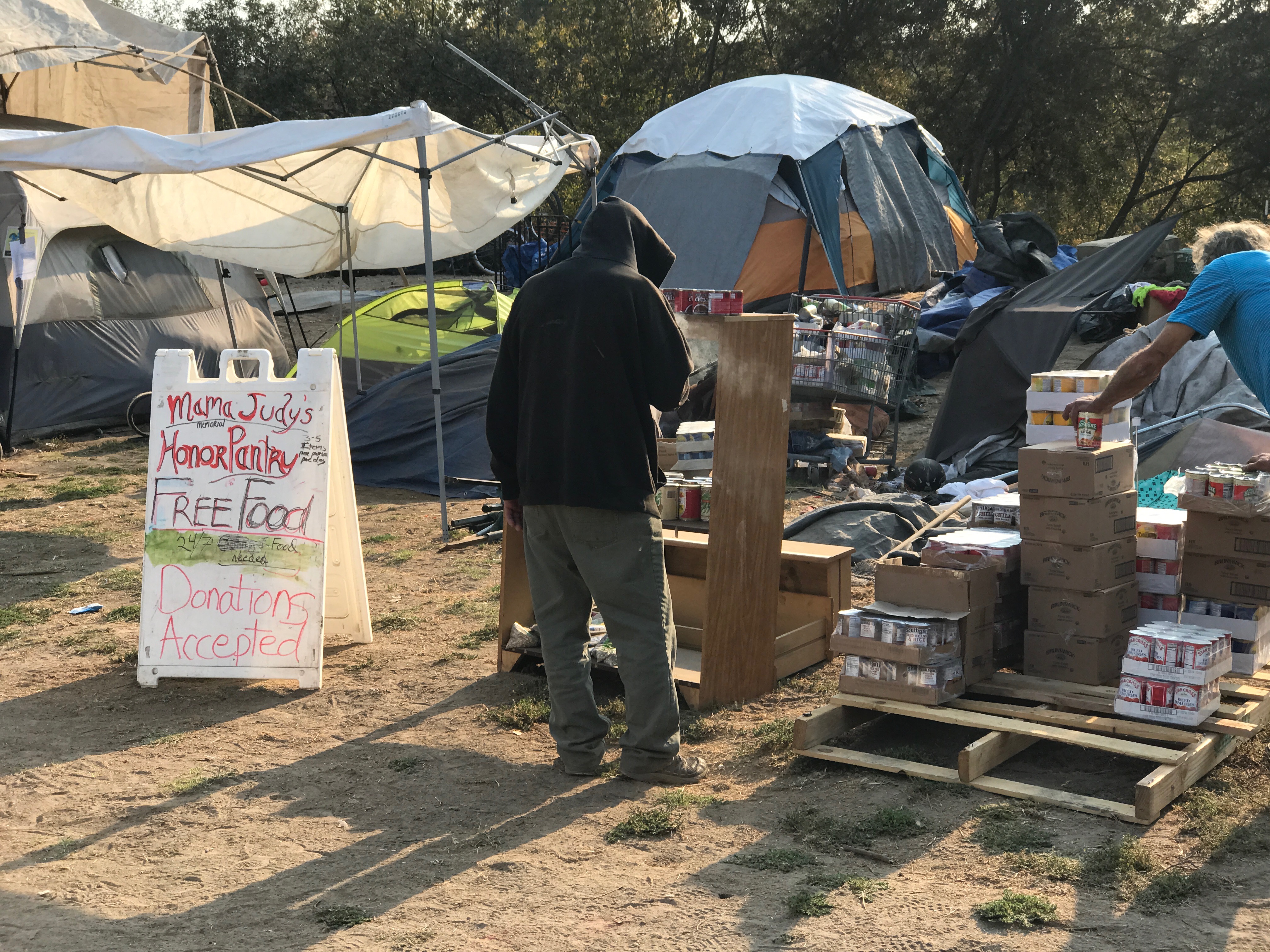
“The staff at the Armory treated me so badly I climbed on the van with my walker and bags and moved to the bushes near the Benchlands,” explained a recently widowed woman in her 70s at the Union of the Homeless meeting this week. She was one of more than twenty Benchland residents who came to discuss the closing of camp.
Another camper spoke about staying at the Salvation Army run Overlook Camp. The van driver didn’t show so she was late to her job. Her employer wanted a note as to why she was late but to do so would tip her boss off to the fact she is homeless and would result in her losing her job. A third pointed out that you have to catch the van before 8:00 pm and if you miss it you have to spend the night on the streets.
At an April City council meeting City Manager Huffaker noted, “We did discover last week that some of the individuals that had secured alternative sheltering sites, for one reason or another, had made the decision to return to the Benchlands,” adding “Part of the challenge that we’re encountering as we move through the closure — and we do think it warrants getting some stronger controls of the physical site in place to help ensure that once individuals are relocating that we don’t have the possibility of folks repopulating the camp.”
The people participating in the meeting voted to invite city officials to the Monday, August 15th meeting so they could hear the voices of those who will be impacted by the announced eviction. They also suggested we request an audit of the millions spent by the city and county on homeless programs. We also agreed to send a letter to the city to get more details on the scheduled evictions.
So the closure of the camp is set to begin. City Manager Huffaker responded to the Homeless Union’s request for details on the evictions saying, “Fencing and closure of the upper park will begin next week.”
According to Jessica York’s August 4, 2022 article “City targets August camp closure” city spokesperson Elizabeth Smith claims “Meanwhile, in the face of a national supply chain shortage, Santa Cruz crews and contractors are limited in their access to chainlink fencing needed to portion off the benchlands camp in phases, Smith said. She added that the city’s likely first visible step in clearing the park will be to fence off the mostly unoccupied upper San Lorenzo Park for restoration, space which houses the park’s duck pond, children’s playground and lawn bowling area.”
The City Manager also responded “Following the closure of the upper park, limited fencing will be installed in the lower park, dividing the Benchlands into segments. Closure of each segment of the Benchlands will be contingent on additional sheltering locations coming online. Our goal is to provide an alternative sheltering option to anyone in the park who wants shelter.
The Homelessness Response Team will be providing their Quarterly Homelessness Response Update at the Council’s next meeting, including additional details and updates on the planned closure and restoration of San Lorenzo Park. Broadly speaking, as mentioned above, the closure will occur in phases, as additional sheltering locations become available. City and County outreach teams are in the process of connecting with every individual in the camp and working to develop a rehousing plan for those interested in alternative shelter.
Food Not Bombs has been delivering more than a pallet of dry goods and produce to the Benchlands every week for nearly 2 years. Our volunteer, Joy Binah drove her blue Honda down to Mama Shannon’s pantry and JP’s kitchen loaded to the roof at 12:30 today, August 11th. As she was helping unload she turned and saw three police officers standing at the front of her car. “I’m towing you right now,” barked officer Ross. Joy asked him to take off his mirror sun glasses and he did. “Why aren’t you giving a warning?” she asked. “This is your warning,” he viciously blurted telling her she had to go up and finish unloading by the bike path.
So Joy drives the rest of the delivery up to the location Ross had directed her too. Two more officers arrive and demand she hand over her ID and Officer Klar writes her a ticket for Drive In A Park.
The city has repeatedly bragged about getting $14 million in funds to “help” the homeless but much of that money will pay for staff. Here is the city’s report on the use of the new money.
Community Relations Specialist (Budget: $111,836)
Public Works Building Maintenance Worker II (Budget: $67,094)
Public Works Homelessness Response Field Worker (Budget: $173,128)
Public Works Field Supervisor and Senior Homelessness Response Field Worker for Homelessness Response Field Division (Budget: $212,733)
Contract with County of Santa Cruz for additional Mental
Health Liaisons (Budgeted: $188,000)
Planning & Proposal Development Consultant (Budgeted: $336,000)
Legislative Advocacy Consultant (Budgeted: $150,000, reduced from $216,000) Land & Resource Management Contractor (Budgeted: $520,000)
Vehicle Abatement Contractor (Budgeted: $37,500)
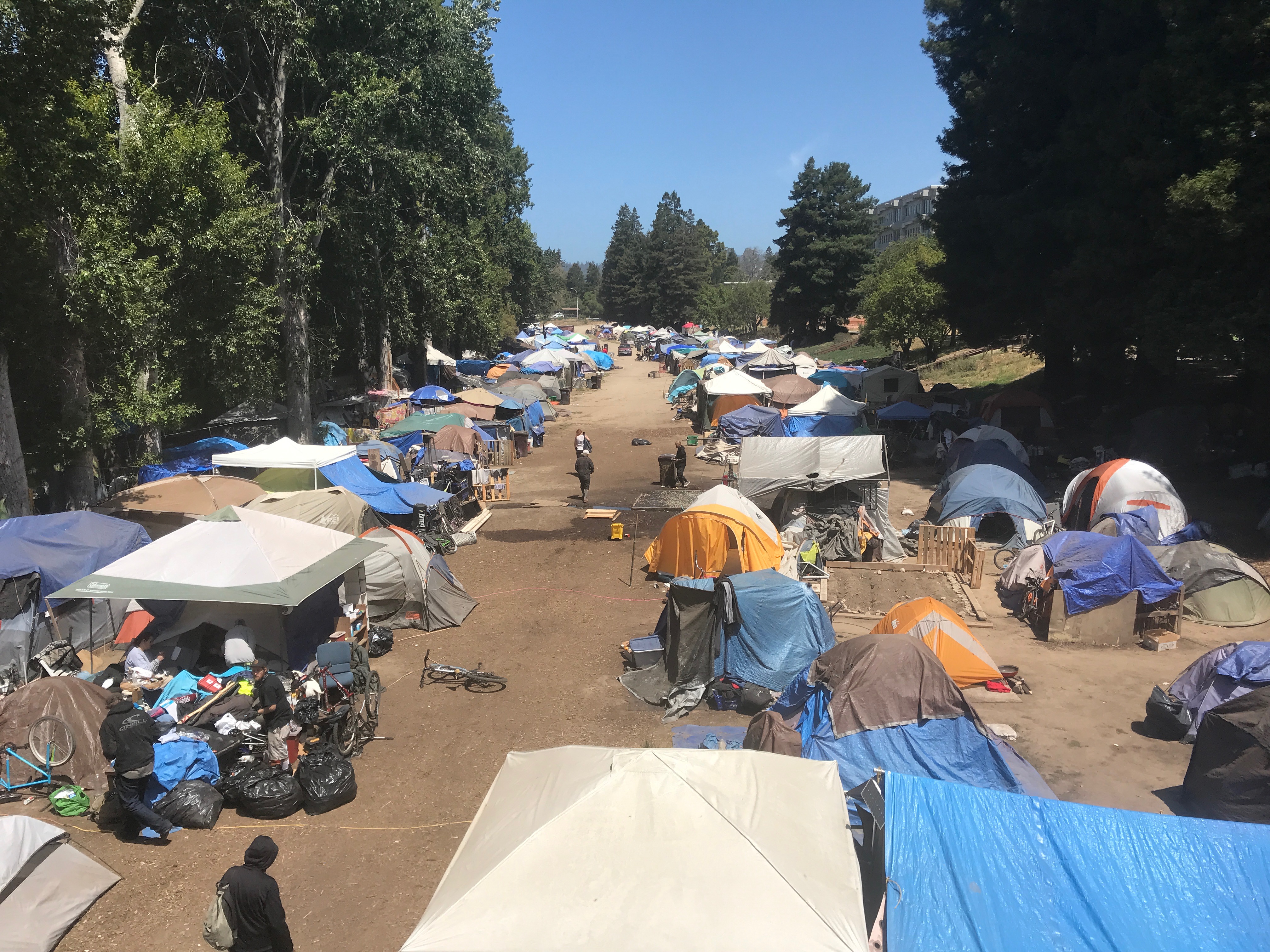
The Homeless Persons Healthcare Project claims about 250 people make the Benchlands their home but the number could be much higher. The Sentinel reported on April 19, 2022, that they counted 285 tents.
The numbers of those living outside is unclear and the disorganization of the February 2022 Housing and Urban Development required Point In Time Count made the programs traditional undercount even less reliable. According to the report there were 2,167 people unhoused in Santa Cruz County in 2019 and 2,299 people unhoused this year.
The Santa Cruz Sentinel August 10th, story on the Point In Time Count at the Board of Supervisors noted “Officials also did not find any unsheltered children younger than age 18 and youth age 18 to 24 saw a 61% reduction in homelessness.” I personally know a number of “unsheltered children younger than 18” who lived outside during the February count.
Early this year, Huffaker announced a goal of July for relocating the Benchlands campers to alternative shelter sites. “So far, the city has relaunched a controlled encampment for about 30 people at its River Street property and recently completed lengthy negotiations with the Salvation Army to open the “Armory Overlook” outdoor encampment in DeLaveaga Park on the National Guard Armory’s south lawn. Opened last month to an initial 20 occupants, the property is slated to hold a maximum of 65 ongoing occupants, with an additional 10 spaces reserved for emergency overnight stays.
In August the number of spaces for those being evicted from the Benchlands remained the same.
About 60 individuals evicted from the National Guard Armory in DeLaveaga Park to the Benchlands in June can return. Another 70 people could move to the pup tents at the Overlook camp next to the Armory but most of those spaces are already occupied by people so desperate they are willing to stay there, and the 30 pup-tents at the encampment at 1220 River Street are also occupied, so in reality of the 160 proposed shelter spaces for the over 300 people now struggling to survive in the Benchlands the proposed shelter spaces are already filled.
If the Benchland evictions happen the City’s misuse of the $14 million will leave the campers to seek shelter in the doorways and roadsides of downtown Santa Cruz or force people into the dry tinder of the Pogonip.
This winter the number of people becoming unhoused is sure to increase and could double by the first of the year.
An August 10, 2022, Associated Press story reports, “I really think this is the tip of the iceberg,” Shannon MacKenzie, executive director of Colorado Poverty Law Project, said of June filings in Denver, which were about 24% higher than the same time three years ago. “Our numbers of evictions are increasing every month at an astonishing rate, and I just don’t see that abating any time soon.”
“According to The Eviction Lab, several cities are running far above historic averages, with Minneapolis-St. Paul 91% higher in June, Las Vegas up 56%, Hartford, Connecticut, up 32%, and Jacksonville, Florida, up 17%. In Maricopa County, home to Phoenix, eviction filings in July were the highest in 13 years, officials said.”
The Public Policy Institute of California reports, with the state’s eviction ban set to end on June 30, almost 1.5 million California renters are behind on their rent payments, and more than 600,000 of them believe that they are very or somewhat likely to face eviction in the next two months, according to recent Census Bureau surveys.
When I spoke with Santa Cruz Mayor Sonja Brunner on August 10th, she agreed that the doorways downtown are already occupied each night by those who cannot find a place to sleep.
LISTEN TO THE VOICES OF THOSE WHO LIVE IN THE BENCHLANDS
Please join us at the Santa Cruz Homeless Union meeting, Monday, August 15, 2022, starting at 6 pm at the Resource Center For Nonviolence, 612 Ocean Street, Santa Cruz.
“I AM DONE WITH THE LEFT-RIGHT DIVIDE. IT’S NOW THE HUMANS VERSUS THE DEADLY ROBOTIC CORPORATE STATE”
July 17, 2022

Keith McHenry of Food Not Bombs is interviewed by Paul Cudenec
Paul Cudenec: Thanks very much for agreeing to this exchange, Keith. It is very encouraging to know that in this age of near-universal deceit and hypocrisy, there are still individuals out there who stand true to their values. First of all, I gather you have a proud family history of fighting for freedom, going back to the American struggle for independence from Britain?
Keith McHenry: Thanks Paul, at this point there is nothing more important than resisting this rush to the totalitarian police state. Our liberty, humanity and connection to the natural world is at stake and we don’t have much time to stop this catastrophe. Events grow more dire every day so, by the time people read this, the devastation of war, censorship, famine and digital slavery may be so severe many in our audience are likely to feel hopeless, but hang in there! This could be a transformation even larger than that of the American Revolution.
Yes, the first member of my family to arrive in North America was a young James McHenry who stepped onto the docks at Philadelphia in 1773. I grew up knowing that he had been on George Washington’s staff during the war. Family history claims a 20 year old James was recruited into the uprising by Dr Benjamin Rush when James was his medical student. James was tasked with starting a field hospital in Cambridge Port in preparation for what became know as the “Battle of Bunker Hill” and met George Washington there. Dr James McHenry was at the surrender of British general Cornwall at Yorktown, participated in the Continental Congress signing the US Constitution as a delegate of Maryland, was Secretary of War under Washington and Adams. There is a fort in Baltimore Harbor named after him where the text of the US National anthem about bombs “bursting in air” was written by Francis Scott Key during the British bombardment during our war of 1812.
Washington wrote of my ancestor at the low point in the revolution during the winter at Valley Forge: “McHenry’s easy and cheerful temper was able to bear the strain which we suppose must sometimes occur between two persons thrown so closely and so constantly together in a position of social equality and military inequality.” Those who know me may say I also have a cheerful temper.
On the other hand I had a grandfather who dedicated his life to defending corporate power. My mother’s father volunteered to join the Office of Strategic Services, the precursor of the US-CIA. He directed the globe’s most deadly bombing campaign, burning as many as a million civilians to death in Tokyo in Operation Meeting House. When I was a child I watched him argue over the phone with his military friends Robert McNamara and Curtis LeMay demanding they drop the nuclear bomb on Hanoi as he swaggered around his office surrounded by photos of his raids on the Japanese city.
These two relatives helped shape my belief that I need to dedicate my life to ending corporate power and at the same time showed me that a mortal like me could have an impact on the direction of society.
PC: It took me quite a while, as a young man, to find my way to anarchism, but I understand you got there at a very early age! How did that happen?
KM: My first step in my evolution to adopting the ideas of anarchism really started in the ancient Hopi village of Old Oribi in what is now Arizona. My father’s father had lived with the Hopis during the Great Depression, becoming friends with the elders of the 2,000 year old stone pueblo. I was witness to the Snake Dance where young men held rattlesnakes in their mouths as the community watched from the roof tops above the dusty plaza. Large drums roared at one end. At the end of the dance, the boys who had just become men handed food to their audience who, like me and my family, were perched on the mudded roofs of the rock homes surrounding the dance floor. This was before electricity had arrived in these majestic lands.
My family also sat on the rim of Glenn Canyon and watched the cement trucks hugging the far wall descending to the mighty rapids to dump their loads into the foundation of a dam on the Colorado River that would, once it was completed, flood hundreds of Anasazi cliff dwellings, beautiful rock ruins I would be one of the last people to see. I was five and six when I stood on the edge of Second Mesa at Walpi hundreds of feet above the burial grounds. The spirits of those whose centuries of graves lay below bathed me in a warm golden wind of eternity, flooding my essence with a feeling that I would always be one with the cosmos. I was witness to a vast wilderness free of the modern contraptions of murder and sterility. That feeling has never left me.
A few years later when my father was a ranger stationed at Shenandoah National Park in Virginia he gave me a copy of “Walden” by Henry David Thoreau. I had just learned to read so I started with the shorter essay in the back of the paperback called “On Civil Disobedience” and that snippet of inspiring text, “I heartily accept the motto, ‘That government is best which governs least’; and I should like to see it acted up to more rapidly and systematically” changed me.
I read that life-changing text when I was in the fifth grade. The Vietnam War was raging. Like many American families we ate dinner while watching the chilling images of the bloody conflict in Southeast Asia with those body count numbers on the evening news. My mother’s brother who I adored was eager to join in the tragedy as a paratrooper. He was spared that horror because he contracted hepatitis in basic training and was hospitalized. The failure to live and die in the jungles as a hero doomed him to a life of self-hate.
Another relative was stationed at the national morgue and gave our family a drive through the Dover Airbase where I was witness to the huge stacks of shiny tin coffins that marched along the tarmac like rows of city blocks. Block after block of caskets waiting to receive the bodies of America’s dead youth.
I lived in the racially segregated town of Luray, Virginia at a time when “colored only” and “whites only” signs were sold at the local Five and Ten shop on Main Street. The murder of Martin Luther King Jr and the riots that followed was another influence that made Thoreau’s night in jail as a tax resister have relevance. Our family happened to head out on a vacation from our home, passing a burning Washington DC and Baltimore and a journey through the black neighborhood of Philadelphia under military occupation. Tanks, gatling guns and helmeted soldiers armed with M-16s and angry german shepherds made an impression. Smoke from the uprising filled our hotel room that evening.
So when I read Thoreau’s argument in his lecture “On Civil Disobedience”, explaining that he had refused to pay his poll tax because he would not contribute to the funding of the Mexican war and a slave state, I saw the similarities to my own time and adopted core aspects of his philosophy.
When I was 14 years old I took my first job cleaning an art gallery. I recall being so happy that I had joined the fellowship of working Americans as I sat on a step of the building across the street eating my first lunch of peanut butter and jelly sandwich. That was also the moment I vowed to never pay for war and started my journey as a tax resister and free person untethered to the state. I was also determined to create my own version of Thoreau’s Concord of seekers. Food Not Bombs became my global Concord. I would cast off the use of my Social Security number after my first arrest when I was 18 years old and lived free from the clutches of the State.
PC: Could you say a little bit about Food for Bombs, how that came about and what it aimed, and indeed aims, to do?
KM: Food Not Bombs is a global all-volunteer movement that protests war and poverty by taking direct action. Our people share the gift of food with anyone, without restrictions, while reclaiming the public commons. We are independent of state and corporate power. Our activists recover food that can’t be sold from groceries, bakeries, farms and distributors, prepare vegan or vegetarian meals that are shared on the streets behind the banner of Food Not Bombs.
Our main goal besides meeting the needs of the poor is to influence the public to take action to force the state to redirect our resources from the military to provide access to healthy food, safe housing, education and healthcare. We are a classroom that practices the philosophy of anarchism without the dogma of the fashion anarchist.
The first collective came together at an anti-nuclear action in New Hampshire, “The May 24, 1980 Occupation Attempt of Seabrook Nuclear Power Station.” A friend, Brian Feigenbaum, was arrested at the protest and we were able to secure his bail from someone with means. On the way home we agreed to hold bake sales to pay the contributor back. That turned out to be a slow way to raise money. We also had a moving company called Smooth Move and one family we were helping was tossing out a copy of the poster “It will be a great day when our schools have all the money they need, and our air force has to have a bake-sale to buy a bomber”. This gave us the idea to buy surplus military uniforms, set up our poster at our bake sale and tell those walking by that we needed help buying a bomber. This got the attention of pedestrians who otherwise would have rushed past, giving us the opportunity to speak to them about the threat of nuclear war, poverty and hunger.
In 1979 and 80 I was a produce worker at a natural food grocery called Bread and Circus in Cambridge, Massachusetts. I took the produce that was wilted or bruised and could not be sold to several families living in public housing on Portland Avenue. One day one of the mothers pointed out the construction of the new glass building across the street from their crumbling housing, noting that it was about to be completed and that scientists who would be designing nuclear missiles would be moving in. This gave me the idea for the name Food Not Bombs.
The street theater of our bake sale was so effective at engaging people who walked past in conversation that we adopted the street theater ideas of the Living Theater. We also started a campaign against the banks who financed and would profit from the construction of the Seabrook Nuclear Station. The First National Bank of Boston was our main target and when we learned that their stockholders meeting would be held on March 26, 1981, at the Federal Reserve Bank we decided to protest by setting up a soup line on the Atlantic Avenue sidewalk outside the towering facility. We asked our friends to join us at a “soup line” dressed as Depression Era hobos with the intention of giving a visual example of the future we would face if we failed to stop the policies of Ronald Reagan, the nuclear industry and banks. The night before the action we realized we had not recruited enough people to look like a soup line so I went to the last surviving homeless shelter from the days of the Great Depression. I spoke with those sitting around the bleak tile room of the Pine Street Inn about the protest. Some recalled their participation in the protests against the Vietnam War and expressed excitement at attending. The next day nearly everyone I had spoke with joined us. Pedestrians rushing past said they were surprised to see a soup line just a month after Reagan had become president. The guys from the shelter told us there was no food for the homeless in Boston and suggested we set up every day. That evening we agreed to do just that.
I started a second group in San Francisco in 1988. The police made 94 arrests of our volunteers for sharing food without a permit that summer. I would learn some 35 years later that the FBI Joint Terrorism Task Force had sent a memo to the San Francisco Field Office about the August 22 arrests, claiming Food Not Bombs was “a credible national security threat”. The arrests sparked interest in other cities so I took my notes on how I started the San Francisco group and made a flyer, “Seven Steps to Starting a Local Food Not Bombs Group” and mailed it to those who wanted to start a chapter in solidarity. During the next few years the city would make a total of 1,000 arrests and with each wave of repression more people would respond by starting their own local group. I also made a point of letting people know they could use the carrot and fist logo and any other Food Not Bombs images or texts without restriction.
I was arrested 94 times between 1988 and 1994 and was framed on three violent or serious felonies and faced 25 years to life in prison, spending a total of 500 days in jail. Volunteers were beaten by the police and our food was seized and tossed out. We organized a system to reduce the loss of meals using decoy buckets with tiny amounts of food.
These arrests in San Francisco, followed by arrests in Florida, inspired the formation of more chapters. Today there are at least 1,000 groups in over 65 countries. We provided the food aid to the survivors of Hurricane Katrina and hundreds of our volunteers helped with Hurricane Sandy. Our volunteers also provided food and material relief after super Typhoon Yolanda smashed the Visayas region of Philippines.
Food Not Bombs has also provided food and logistical support for direct actions to defend the environment, indigenous sovereignty, strikes, anti-war actions, Occupy and many other anti-globalization protests including the WTO blockades in Seattle in 1999 and Cancun.
Maybe the most impressive action we inspired was the uprising against the corrupt government of Iceland that resulted in the collapse of the political leadership and the jailing of several bankers. It is clear to me that Food Not Bombs must step up our organizing efforts as the planned economic calamity of 2022 will make the 2007 financial crisis seem minor by comparison.
Our four decades of organizing against international economic policies takes us to the point where we are today, where we need to take action against the “Build Back Better” stakeholder capitalism policies of the World Economic Forum, the World Health Organization and other global corporate institutions. There is a continuity in our founding resistance to corporate plunder and its ravages of poverty and war outside the Federal Reserve Bank in Boston and our resistance to the trans-humanist totalitarian technocratic globalist policies threatening our humanity and Earth today.
PC: What projects were you involved in at the start of 2020 and what was your initial reaction to the Covid moment?
KM: I had just returned from three weeks in Guatemala where I had been writing a book about my life when news came that a deadly pandemic was about to sweep the country. I had intended to continue writing and help with the preparation and sharing of our weekend meals but that changed four days after my arrival in Santa Cruz, California.
When we learned that the indoor meal programs for the homeless and poor had been ordered to close on March 14, my local Food Not Bombs group agreed to fill that void. If we didn’t start sharing food and water with the unhoused community, hundreds of our friends would go hungry and suffer from a lack of drinking water.
That morning we met to formulate a plan on how to share meals safely under the reported conditions. We moved our weekend meal to the Clock Tower, a public plaza across the street from where we shared our normal weekend meal because about 20 people were camping up against the fence that protects the Post Office from the homeless. We didn’t think it was wise to have a line of over 100 people standing so close to people and their tents.
Like many other people in our group, I had the impression the crisis would last a month or so and the other food programs would reopen. That was at a time when the authorities were claiming we needed “two weeks of quarantine to flatten the curve”. So we set up a daily meal, our DIY hand washing station and a distribution of survival gear in solidarity with our local homeless organization, calling our project the Santa Cruz Homeless Union COVID-19 Relief Center and Food Not Bombs meal.
I remember being impressed to hear that many of my unhoused friends found that the lockdown was liberating. Everyone, housed and unhoused, was united in this chaos. Many people who lived in the streets told me on day one that they thought the whole fear story was a scam and nearly every unhoused person who I spoke with claimed that their rough life would make them immune from any plague. None of my homeless friends worried about getting COVID. The only concern they had was being able to get drinking water and something to eat.
It seems crazy now but in the first weeks of the pandemic we had an aggressive policy of wiping down our tables and our delivery van with bleached water. We wrapped caution tape looped through large yellow Trader Joes grocery lugs that we placed around our serving tables to add distance between the servers and the people coming to eat. A week later we spray painted white dashes in six-foot intervals for social distancing along the sidewalk leading to the serving area. The police claimed the virus could be passed from person to person if we continued the practice of letting people rummage through our clothes donations and, to avoid being shut down, we had volunteers hold each item up so our friends could decide if it was something they would need.
That same week the City erected homeless triage centers in downtown parking lots that were nothing more than chain-linked cages with a couple of portable toilets. The mayor of the city stopped at our meal and asked us to move to a location where we could help them lure the unhoused into their cages. I refused. I wouldn’t let them use the trust we have with the unhoused to intern those who live outside. They abandoned their program a couple days later after they realized the unhoused were not interested in cooperating. The governor of the state announced that the government would provide millions to buy or rent hotels for the homeless to quarantine but our city and county refused to take them up on the offer, even though we are a tourist town and the hotels were nearly empty. Our city leaders have been vocal about the unhoused being less than human and not worthy of help, which was at the core of their refusal to move everyone inside.
I remember thinking this could be the beginning of an economic collapse and that we needed to prepare. It looks like I wasn’t far off the mark. Our Food Not Bombs chapter ordered a truck load of dried goods from Second Harvest Food Bank. Twenty or more pallets of rice, beans and canned goods were unloaded outside the kitchen we were renting at the time. But the county government took over the facility to shelter a couple dozen unhoused people in pup tents lined across the auditorium above the kitchen. We had to find a new place to cook and moved our pallets of food to a closed restaurant and a 20-foot refrigerated shipping container we had secured a year before with a grant from the food bank.
My girlfriend Kathleen was a social worker at two local hospitals. Patients said to have COVID were wheeled down the hallways under plastic tents on their way to a COVID floor. The first days had a feel of a dystopian science fiction movie. Radio and TV programs blasted out doom. They screamed that we could all die if we didn’t obey. Nonstop fear, homeless triage cages, images of body-bagged people being wheeled to refrigerated trucks, health officials standing with Trump announcing emergency measures. We all witnessed the media madness. This was my first tip that there was another agenda other than public health.
It is no wonder those locked into their homes lost the plot. If you didn’t venture outside you would think, from the constant terror on the media, that the streets were littered with the dead.
I had just sold my permaculture farm in New Mexico and was given a financial award by a group to honor my dedication to promoting a vegan lifestyle, so I had a bit of money for the first time in my life. In an attempt to build pressure to provide dignified accommodation to those forced to live in the streets, I paid for eighty beds and announced I would be providing hotel vouchers at 6:00 pm that evening. Over 100 people arrived and the crush of desperate people seeking for a chance of a night in a bed and a hot shower was heartbreaking. The chief of police declared it a violation of COVID gathering restrictions, telling the media that we were holding an illegal rally rather than providing a chance to sleep in a hotel for the evening. I was able to pay for two more nights for 180 people and the local shelter asked me to put up half their people on the fourth night. I was investigated by the police for handing out counterfeit hotel vouchers but they never took me to court.
The county government was offered millions to provide hotel rooms but at the height they placed less then 150 of the over 2,000 people who lived outside in their empty motels. This was a sign that they did not value the unhoused as fully human. In the early months of the crisis there were more than 2,000 unused hotel beds in Santa Cruz since tourism was over for the near term.
During the first months of the lockdowns, the streets of Santa Cruz were empty of vehicles. If I happened to pass another motorist I would wave and they would nearly always respond with a nod or gesture of their own. The public restrooms were closed and drinking water was scarce. The only people walking the streets were those who lived outside.
The largest challenge was calming the violence and acting-out of those who were already suffering from mental health issues. The tension was intense in those early days and those people who were already having emotional difficulties really freaked out, making the sharing of our meals otherworldly. Lots of yelling and fights. There were times when I had to step in and keep people from beating someone to death. But we didn’t stop and have been out on the streets sharing food and water with our community for nearly 900 days in a row now., with services that the governments are refusing to provide.
Since we were the only group making sure those who lived outside had food, the public was generous and we were able to buy two more 20-foot shipping containers which we have stocked to the roof with dry goods. We also bought a water filtering system to clean the river water if the electricity failed, which is a real possibility here in the world’s fifth largest economy of California. We also prepared to cook outside in the event that gas is cut off, stockpiling propane tanks and stoves.
There was a massive forest fire that forced hundreds of people from their homes. A thick red smoke blotted out the sun for days. Fire evacuees came to us not only for food but to replace their lost clothing. We also have been giving out cheap pup tents to those who have just moved to the streets or had their vehicle or tent confiscated by the city.
We defied the fear with our introduction of a free solar-powered concert at our meals during each holiday. People danced to the live music and enjoyed each others’ company. While most people were isolated in their homes receiving food from delivery services while glued to their computer screens, our poor and homeless friends were free. In the first two years only two of my unhoused friends reported contracting COVID. Crystal worked nights at a shelter and she felt ill for two days. Dream Catcher slept at the shelter and was sick for a week. Everyone else I met who said that they had caught the dreaded disease lived inside and did as they were instructed. They had cowered before their TVs and computers and resisted the temptation to interact with other humans.
We frustrated the authorities with our gatherings but there was little they could do. The jails were full and when they did arrest our friends the police released them as soon as they arrived outside the jail gate. The courts were closed for nearly a year so we ignored our charges and went on with our lives. I remember one of our homeless volunteers was ticketed for violating the quarantine. His citation was for $1,000 and his address was marked as “transient.” He ignored it, other than to show it around to highlight the insanity of our times.
We were free. We weren’t afraid.
The Homeless Persons Healthcare Project has been aggressively injecting people, offering the unhoused $50 gift cards. It has only been in the past few weeks now that my homeless friends have started to report that they are very ill with COVID. All of those I meet who now have COVID have been injected. None of my unvaccinated friends have been ill with COVID in over a year now.
PC: So all this changed your overall understanding of the situation? How would you now describe what has been happening over the last couple of years?
KM: In the first weeks of the pandemic I feared for the worst. I recall posting negative comments about those who questioned the official narrative at first but the fear narrative around COVID was being pushed nonstop in the media, suggesting there was more to this than public health. I was also witnessing that no one I knew who, according to the screaming media should be dying, was ill. Each day I saw that the only impact was closed stores, empty streets and shuttered food programs, which increased my belief that the pandemic was not as severe as advertised.
When Trump announced the Operation Warp Speed, that got my attention. A military program coordinated with some of the largest pharmaceutical companies in the world suggested there was more to this drama than concern for public health. The endless announcements that each program was sponsored by the Bill and Melinda Gates Foundation didn’t add to my confidence that this hysteria was based in reality. I had spent the past two decades organizing against the Gates of the world and the patenting of his GMO seeds with groups like the Organic Consumer Association.
Since I have been the direct target of covert disruption by state intelligence agencies for the past four decades I am naturally suspicious of official narratives. The media lied us into war after war so this had the same feeling as the WMD of Iraq, the babies taken from Kuwaiti incubators, the Gulf of Tonkin incident and other disinformation campaigns of the past.
It wasn’t long after that that one of my closest friends, Dr. Shannon Murray, came to Santa Cruz to visit Kathleen and me. She was on her way to start a new life since her employment as a scientist had vanished. She is a virologist and an expert on gain-of-function research.
I knew her when she was helping develop the Moderna vaccine at the National Institute of Health in Bethesda, Maryland. She feared there could be major health problems from the vaccines since the first human trials had not yet taken place and more study was needed before they could be considered safe. She shared that the animal trials had not been promising, killing nearly 80% of the vaccinated animals who were exposed to SARS-CoV-1. She also expressed concern that research in these vaccines had abruptly become a secret military program, sharing that her access to data had suddenly gone dark in January. At that time she was still using an alias, as did her coworkers, so they could share their concerns without fear of being banned from their life’s work or murdered like former Merck Pharmaceutical sales executive Brandy Vaughan, who was killed just as the pandemic was being announced. Like some of those she worked with at the NIH, Shannon refused to get the COVID jab and encouraged us to refuse as well.
As I said, my girlfriend Kathleen worked at a local hospital in a COVID wing. As the days passed she failed to see the deaths suggested by the news. Sure, many elderly people filled the section but few succumbed to the virus. Once the vaccine program began she would return home to share one story after another of the stroke and heart attack patients who had just received their first jab. Those injected were fast becoming the people who filled the ICU unit. They were the ones leaving in the body bags.
Sharing food every day outside also made it clear that the official story was false. Every day a hundred or more people would gather together to eat. No one said they had contracted COVID or shared that they had the symptoms. The deaths of our friends came at the end of a needle of fentanyl-laced heroin and meth or from the brutality of a life lived unprotected from the elements.
When I saw people the media called anti-vaxxers armed with AR-15s waving confederate and Trump flags at protests against the lockdowns I was horrified. There is no way I would ever join people like the Proud Boys and Trump supporters in demonstrations against COVID policies. The questioning of Dr Fauci was framed as a position taken only by racist gun-toting Trump supporters, effectively driving my friends in the left into the arms of the military and big Pharma. It seemed every leftist friend had retreated to their apartments in fear of dying.
I had the impression I was one of only a couple of progressive activists that thought something wasn’t right. I would slowly learn that several other left friends also shared my perspective. I connected Shannon with an old journalist friend, Sam Husseini, who had been writing on gain-of-function research and bio-warfare programs at places like the Fort Detrick Biological Warfare Laboratories. I learned that another colleague of mine, the director of the Organic Consumers Association, Ronnie Cummings, and my associate Vandana Shiva were also expressing concerns that mirrored our work together against Monsanto. So even though I remained publicly silent, worried my opinion could cause harm to the Food Not Bombs movement, I started to feel less alone. This was the era where, in desperation, I started to post cryptic messages about understanding how people like the artists Käthe Kollwitz must have felt as everyone she knew seemed to have signed on to the National Socialist agenda during the march towards World War Two. I did get some confused comments.
When my dear friend in her 40s messaged me from Australia that she almost died from myocarditis I could not be silent any more. That was the last straw and I became a vocal opponent of the jabs.
I first wrote a letter on this subject when I received an invitation to attend a meeting forming a new progressive alliance. To participate you had to provide proof of a vaccination or a negative COVID test. I wrote to invite the progressive community to stand in solidarity with the working class by refusing to meet in facilities that demand proof of participation in the vaccine experiments. Nearly every “essential worker” I depended on for auto repair, printing and other supplies shared my perspective on the COVID clampdown. The left I had known stood for workers’ rights during the first four decades of my life, but that had changed. We had become tin foil hat deplorables even though those smearing our position depended on us to provide for their needs.
Before the invitation to this meeting asking me to help start a new progressive group, I had shrugged off the proof of vaccine requirements. I ignored the proof of vaccination requirement for attendance to the American Civil Liberties Union awards ceremony since I couldn’t go anyway because I had to cook that day. I later learned that the outdoor venue for the meeting did not require this proof, nor did the Simpkins Family Center where the progressive alliance was intending to meet. My allies were the ones implementing this policy. Allies I know had been sitting at their computers during the entire pandemic and rarely went outside to see reality. One of the organizers kept trying to get me to be “an example for the community” by getting “vaccinated”. I patiently explained the reasons I would never subject myself to the poison but he continued to pressure me.
I also had friends that were eager for me to attend the opening of the documentary “Foodie for the People” that had a section that featured me and the work of Food Not Bombs. The filmmaker was excited to tell me that he used a clip from his interview with me to promote the film. The announcement for the film required proof of vaccination or a negative PCR test. But I also learned that Del Mar Theater, where the movie was being shown, didn’t require proof of vaccination or a negative test yet those showing the movie had made it a requirement.
The final insult was the day I went to my favorite activist cafe and was told I could not enter unless I could show proof of vaccination. That was it. I had been outside nearly all day, every day of the pandemic. I never spent a second inside being quarantined. I could see the reality of the pandemic with my own eyes. I couldn’t remain silent any longer.
I wrote an essay, “Looking at COVID as a Progressive” that I posted online and emailed it to the community. That broke things open. By the end of the week I started to get emails and calls of relief from friends who had been silent, believing they too were alone in feeling that the pandemic restrictions were part of a power grab.
One of the most discouraging aspects of the psychological operation was to see posts by Food Not Bombs groups promoting the vaccines and masks. One New York chapter shared an announcement that people could come to our meal and get vaccinated under the headline SAFE – EFFECTIVE – FREE. Another chapter posted an announcement to an outdoor protest in late June 2022 with a large type demand to “Wear Masks”. To see the movement I helped start actively support a totalitarian corporate agenda has been heart-breaking.
PC: Are there now many others in your circles who share your dissident take?
KM: Thankfully several of my close housed as well as unhoused friends are on the same page. As I pointed out before, my many of my homeless friends didn’t fall for the fear campaign right out of the gate. I was heartened when I watched The Convo Couch podcast early in the crisis and heard Pasta and Fiorella express the same bewilderment at our friends and allies pushing the agenda of those we had spent years organizing against. Glory and Steve at the Slow News Day also expressed amazement at the way in which those who once stood with us in the issues of workers’ rights, resistance to mega corporations and the military had become vocal defenders of those threatening our freedoms. After I posted “Looking at COVID as a Progressive” my circle doubled.
PC: Two things surprised me about the reaction of the rump of the left, including anarchists, to Covid. The first was the position they took, completely accepting the official line and supporting masks, lockdowns, social distancing and injections. The second was the way that this was not just an opinion, but an article of faith which had overnight somehow become ideologically essential. If you questioned government, opposed Big Pharma, exposed the links between the two or stood up for individual freedom, you were suddenly considered “right-wing”! The vitriol and vehemence with which I was attacked really shocked me. Did you experience anything like that?
KM: I have often been called a Trumper or right wing by my anarchist and other left friends during this insanity. People are not so bold any more but for the first two years people said they were shocked that I had become a far right Republican Trump follower since I had been known as an anti-war leftist. I think the fact that I have been out on the streets for nearly 900 days, sharing food when the state provided nearly no support at all for the unhoused, has made it difficult for local people to express this opinion openly to me. I am also seeing less of these direct attacks on social media now. I find it interesting that my allies in the anti-globalization and peace movements do not see a connection between our protests against the Weapons of Mass Destruction lies before the Iraq war, GMOs, a woman’s right to choose abortion and big Pharma but now are public about supporting forced vaccination, censorship, and the war in Ukraine.
PC: I have spent a lot of time trying to work out exactly why the left/anarchist scene collapsed so dramatically as a force for resistance in the Spring of 2020. Do you have any thoughts on this?
KM: Based on my having survived four decades of state and corporate intelligence agency disruption, I believe I have an educated guess. It looked like there was an effective strategy linking covertly controlled far right groups waving Trump and Confederate flags and AR-15s with opposition to the COVID policies. I know I didn’t witness any other left anarchists denouncing the policies in the first months so like many others who may have shared my perspective I thought I was alone. The headlines of most corporate media blasted stories like “Coronavirus: Armed protesters enter Michigan statehouse” with the media showing footage of protesters outside state houses chanting “Let us in!”, “Let us work” and “This is the people’s house, you cannot lock us out”. Before COVID, unarmed leftists would have been the ones chanting these slogans but the images of Trump-supporting, gun-toting anti-lockdown protesters helped shape the narrative. In the early days of the crisis, the Los Angeles Times had a story showing a Proud Boy Nazi with swastika tattoos stabbing a pedestrian during a lockdown protest.But this is only one of the many aspects of the psychological operations that was effective. The use of media to repeatedly claim isolation, masking, social distancing and shots were all about protecting the community and for the greater good of all, fed into some of the core beliefs of the left. No self-respecting leftists wants to be accused of being selfish.
The left also did not want to be anti-science and since all alternative ideas were censored or attributed to tin foil hat Qanon Trumpers it became a badge of honor to smugly sneer at those ignorant hillbilly deplorables.
I also think that those in power were clever and their foundations started to fund a loyal opposition with haste when the Democratic Party chose Biden as the leader of the regime. One of the first reports on the popular left program Democracy Now! featured Peter Daszak of the EcoHealth Alliance claiming a bat virus in a Wuhan wet market was the likely source of the Pandemic. My friend, investigative journalist Sam Husseini, was never asked to refute Daszak’s claim even though Sam had several articles published in April 2020, on the history of gain-of-function releases at American-funded bio-weapons laboratories, a dramatic subject that would have interested Amy Goodman before the crisis. The host Amy Goodman breathlessly reported on the refrigerator trucks outside New York City hospitals. She was all in on the official COVID narrative and that has had a major influence on the American left.
Foundations have helped to co-opt as many left organizations as possible. Most of our allies accepted their support, surrounding the left with community groups who danced to the tune of Gates, Soros and other philanthropists. The funding of the non-profit industrial complex is often a means of controlling dissent in the United States. The messaging was unified and total. It was intimidating. My early posts of “I always support secret military programs and Big Pharma”, in my ironic response to social media demands to comply with the totalitarian program, were either mocked or commented on with confusion. Reminding activists of our struggle against the World Trade Organization and its direct line to the proponents of a digital slavery of vaccine passports, and other programs of globalist associations like the World Economic Forum and The World Trade Organization, seems to have evaporated with the fear of COVID and the potential of being mocked for not going along with the crowd.
PC: How do you see the relationship now between the likes of you and me and those we previously called our comrades? Have the division lines softened at all over recent months, as you maybe hinted, or are we looking at a decisive rupture, do you think?
KM: It could take many years for a large portion of our allies to join the struggle even as they are forced to participate in an ever-increasing digital slavery. The impact of Mass Formation has been effective. But there is some hope. I often attend a Freedom gathering on Sunday afternoons and of the 30 or 40 people who participate at least half are left activists and the other half are Republicans. I am witnessing a shift where people on the left are now silent about anything to do with COVID and are starting to focus on the economic collapse and the dire conditions we face. Many are even starting to become quiet about their worship of Zelensky now that a Ukrainian victory is less certain. They are not ready yet though to connect the COVID program and war to the march towards the Great Reset. As events spin out of control, it is possible there will be some unity around some aspects of the Great Reset if it is presented as an attack by global capital, but the mass vaccine area of this program may be impossible for our friends to see and they may continue to support things like censorship, digital passports and mandates. It seems that even as my fully vaccinated friends keep getting COVID or die of strokes and heart attacks, that they are so wedded to the narrative that they are not able break out of the trance.
PC: How should we go forward from here? How can we best build new alliances of resistance without compromising our core values which, for me at least, remain exactly the same as they were before Covid?
KM: This is a tough question in light of the global chaos and successful divide and conquer strategy of capitalism. One path is to build local systems of mutual aid so we can survive. The war on thought is unrelenting. Building local communities that support one another emotionally and with the necessities of life may be our only alternative. Food Not Bombs history may provide some guidance. We have intentionally formed a non-hierarchical decentralized system of organization that seeks to address the needs of the community. Housing with Homes Not Jails, transportation with Bikes Not Bombs, Food Not Lawns, Free Radio, Composting, and of course the food of Food Not Bombs. The other key idea one could take from 42 years of Food Not Bombs is a joyous welcoming atmosphere that encourages dialogue by providing literature, music and theater with the necessities of survival gear and a hot meal. Evading the violence of the state may be difficult and strategies of self defense need to evolve.
On the points connected to the fear of COVID, many of our former allies may be lost to us for decades to come but on the issue of digital slavery, police repression and the economic collapse we may have some unity. As difficult as it can be, I make a point of being understanding of those who worship the COVID narrative, always make sure they know I am unvaccinated and move my conversations towards our shared history of resisting the corporate exploitation and the economic slavery of the global institutions.
The latest preplanned trauma in the United States is centered around the divisive issues of guns and abortion. There is, however, an intersection around privacy and personal autonomy with those who are pro-choice on the issue of abortion and those who want the freedom to refuse the jabs. There should be unity with the principle that censorship is never justified, but so far anarchists are still on the “silencing uncomfortable ideas” train. And there must be universal agreement between the left and right for the need to end war in Ukraine and an urgent demand to ban all nuclear, chemical, and biological weapons.
As free thinkers we can encourage a great transformation of the human spirit where we find solutions outside the left-right paradigm. That discussion and search must continue in earnest. I am done with the left-right divide. It’s now the humans versus the deadly robotic corporate state. My message in my 1992 book “Food Not Bombs, How to Feed the Hungry and Build Community” was to organize against the death culture of state and corporate power. That remains my perspective today, only now this fight must find a solution and fast. We need to form a strategy that is difficult for the intelligence agencies to disrupt, builds solidarity and threatens the power elite while nurturing a thriving community. The anarchist theories of decentralized local autonomous social structures I believe are key to survival. Total noncooperation with the system while operating survival projects independent from state and corporate institutions is the path I am taking.
We are nearing a point where the goal may be having food and shelter while avoiding being interned or killed by those loyal to the Build Back Better stakeholder capitalists. As I respond to your questions, I worry my comments won’t reach the public before the first nuclear weapon is launched or we are captured and removed from society for our thought crimes.
Santa Cruz Officials Puzzled By Reality
June 17, 2022
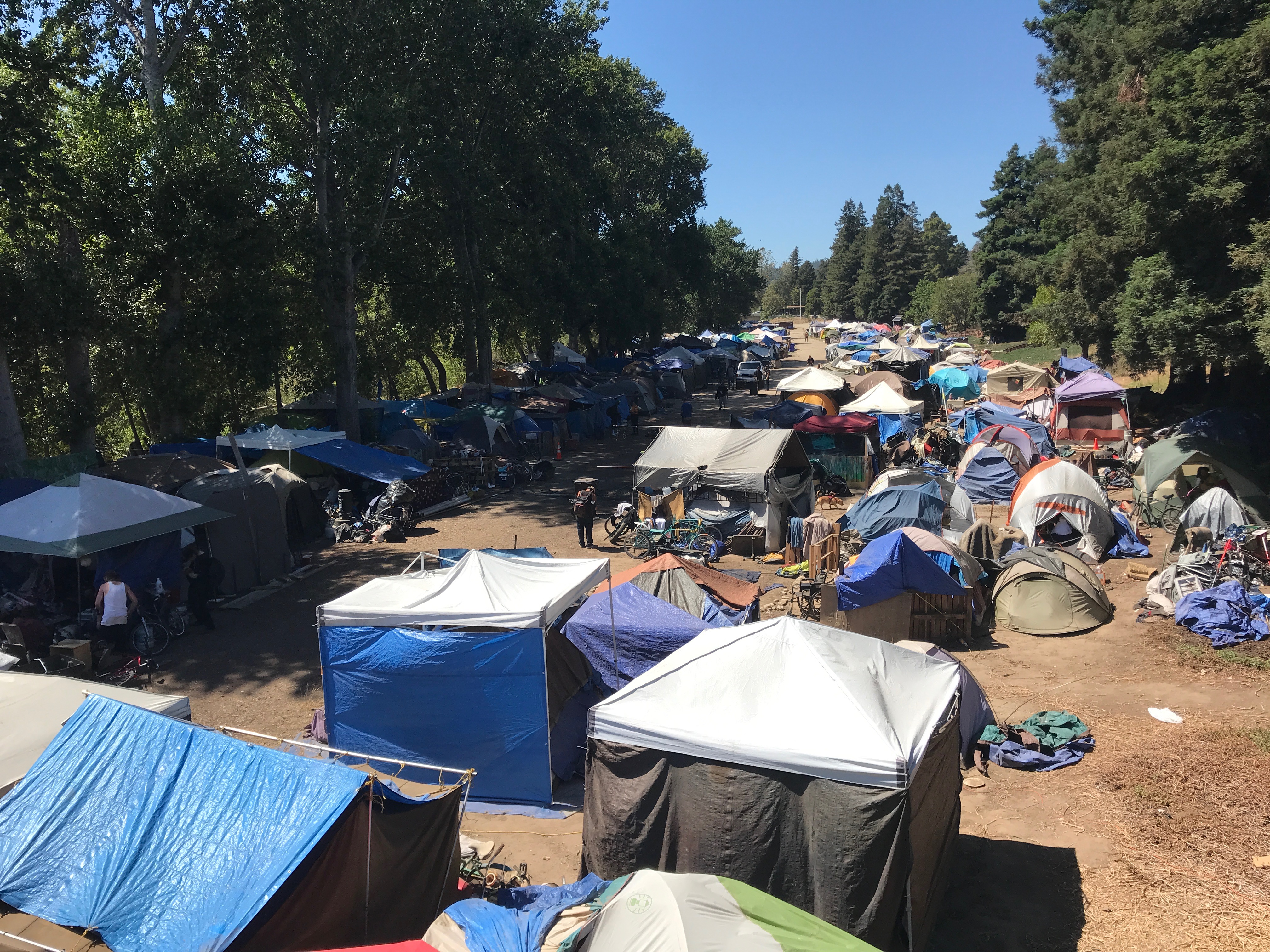
I was walking along River Street when I came upon two of my friends at the Armory Shelter van stop outside Garage 10. I asked them if they were staying in the Armory. “No we are in the prison camp next to it,” one said as the other nodded in agreement. I asked if they were provided tents. The tents were there when they arrived. I asked if they had canopies over them. They didn’t. “Its too hot to be in the tent,” she added noting that the van schedule almost made her miss her job. She tells me that the camp is already nearly full as is the Armory next door. I told them that several friends told me they went up to check in and left saying it was like an internment camp.
Ross Camp Hero Robert Woodlief was the first to tell me that those who went to check in at the tents outside the Armory were horrified and declined to stay. Like many of those who eat at Food Not Bombs he lost his vehicular home to the city tow truck. He moved to the Soquel end of the ever expanding Benchlands camp.
I walked over the pedestrian bridge to take a picture of the Bull and Bear Fights plaque on the Dakota Street side of San Lorenzo Park. Wall Street stocks collapsed into the Bear Market that morning. The terms Bull and Bear Market come from the bull and bear fights popular in America at one time. The monument reminds us that Bull and bear fights started in San Lorenzo Park in 1797 ending on July 13, 1867. The people of Santa Cruz placed bets on which would survive, the bull or the bear.
I strolled up and down Pacific Avenue taking photos of 19 of shuttered retail stores between Mission Street and Laurel. There would be another block of bankrupt shops but they were cleared for a luxury condo project.
I snapped a picture of the expanded camp Soquel side of the pedestrian bridge. “Hey don’t take pictures,” yells up a man hidden by a blue tarp. He sticks his head out, “Oh you’re Keith, thats ok.”
I turn and snap a long shot of the Water Street side of the camp. The numbers of people moving to the Benchlands is growing everyday. It’s a tough situation for anyone to live on the dusty flood plains. I am amazed at the relative cooperation of people struggling with such diverse conditions and difficulties. The one thing they all share besides the challenges of survival is that they can come and go as they please. They are free and independent.
I see Blue smacking golf balls towards the Duck Pond with his driver. “I thought you moved into a place in Ben Lomond?” I ask. “The landlord kicked me out after the first night saying I wasn’t family,” adding that he still has a housing voucher. “I moved in over there.” He points to a tent in the flats. Another Benchlands resident Greg Bengston comes by and shares that the accommodations next to the Armory were so inhumane that he wasn’t willing to move up there.
Greg also explained that the water faucet in the camp had been shut down for at least four days. “When we showed up inside the county building looking to fill our five gallon jugs the staff apparently called the city and the water was back on that afternoon.”
Greg added that he overheard city staff person Jeremy Leonard telling some of the older Benchland residents that they had to move out by the end of the month and that the police Swat Team would be clearing out the camp in July.
A community with some of the world’s wealthiest residents should be able to do better by members of their working class neighbors, many of whom have helped build Santa Cruz. I have unhoused friends like Robert who poured the concrete and nailed the frames of those very homes some of them now enjoy.
The City plans to evict several hundred people from the Benchlands camp in July. They will end up living in the doorways, woods, levees and roadsides of downtown Santa Cruz if we don’t stop them. The locations that the City plans to move people too are already occupied so there is no place for people to go. See what they have to say in their official report of May 5, 2022.
FROM THE CITY COUNCIL AGENDA REPORT – 05/05/2022
As a result of the closure of the Cemetery and Hell’s Trail camps, the number of persons camping in the Benchlands has increased significantly compared to the beginning of the year. Earlier this year, Council provided staff direction to work toward closing the Benchlands to camping, and on April 12, 2022, the City Manager reported to Council that staff are working towards a closure in July 2022. Staff is in the process of developing an operational plan for the closure to camping on this timeline, along with a plan for the restoration of the area to its intended use as a park that is utilized by the entire community. Several factors critical to the success of this effort are already underway, including expansion of existing shelter capacity in the City, along with collaboration with the County to expand case management, service connections, and rehousing efforts for persons camping in the Benchlands in advance of the closure.
The May 5, 2022, Agenda Report claims they hope to provide safe sleeping spaces or cots for a total of 315 people. On April 19, 2022, the Santa Cruz Sentinel reported that they counted “285 tents set up along the San Lorenzo River from the Water Street bridge to the Soquel Avenue bridge”. A few dozen people were cleared from Sycamore Grove and other areas along Route 9 during the first week of June, increasing the population of the Benchlands once again. Each of the “shelters” they plan to move people too are already full so either the City will evict the current occupants into the streets to make way for those being removed from the Benchands camp, or those in the camp will be forced to find a place to be in the streets or the Pogonip forest. Its just as simple as that, a cruel shell game. If the celluloid avatars at City Hall thought those who live outside as human they would never inflict such suffering. But they see our unhoused friends as rodents to be eradicated.
As the economy crashes the number of people being forced to live outside is sure to increase. It is clear that the city and county are not prepared to welcome hundreds of additional people who will become homeless and will be seeking a safe place to live.
The May 5, 2022, City Council Agenda Report lists the 315 possible locations including 60 cots at the Armory, the camp next to it, and the old maintenance boneyard at 1220 River Street. But these are already full so unless they evict all those people into the streets to replace them with people from the Benchlands it’s not really clear what the City is seeking to achieve. Make 300 people’s lives even more unstable?
The local homeless industrial complex is awash in funds but little is available to house those forced on to the streets. In a May 18, 2022, article in lookout.co on the closing of the last COVID hotels Santa Cruz County spokesperson Jason Hoppin, claims the county will have spent $73 million on the program’s emergency shelter program. But this is just a fraction of the millions flowing into the pockets of those administering our well financed system of poverty pimps.
So this is the list of priorities they outline in the City’s May 5 agenda report:
City staff positions already approved by Council on March 8, 2022
Deputy City Manager (Budget: $????)
Homelessness Services Coordinator (Budget: $????)
Homelessness Response Outreach and Shelter Specialist (Budget: $????)
Community Service Officer (Budget: $????)
Community Relations Specialist (Budget: $111,836)
Public Works Building Maintenance Worker II (Budget: $67,094)
Public Works Homelessness Response Field Worker (Budget: $173,128)
Public Works Field Supervisor and Senior Homelessness Response Field Worker for Homelessness Response Field Division (Budget: $212,733)
Contract with County of Santa Cruz for additional Mental
Health Liaisons (Budgeted: $188,000)
Planning & Proposal Development Consultant (Budgeted: $336,000)
Legislative Advocacy Consultant (Budgeted: $150,000, reduced from $216,000) Land & Resource Management Contractor (Budgeted: $520,000)
Vehicle Abatement Contractor (Budgeted: $37,500)
The agenda report continues with a section on their Over Size Vehicle Ordinance Implementation and Safe Parking Program has this to offer:
The OVO was adopted by Council on November 9, 2021.
Several key elements of the OVO include parking restrictions on City streets between midnight and 5 a.m., a new residential permit program, and the restriction of discharging sewage or greywater on streets or in storm drains.
Tier 1 Emergency Safe Parking (3 spaces total)
Tier 2 Multiple Safe Parking Sites (30 spaces total)
Tier 3 Operator Supported 24/7 Safe Parking Site (15-20 spaces total)
When you first face homelessness and have some resources families often buy a large van, SUV or RV to move into. So Santa Cruz can anticipate a huge increase in people seeking the shelter of their vehicle and now face having their new home towed, added to the stress of sky high gas prices.
I get a frantic call from Santa Cruz Homeless Union President Alicia Kuhl on June 16, 2022. Her RV was gone. At first she thought it had been stolen. A friend had been living in it since she had finally after a three year struggle to find housing for her family. Her friend had moved from the vehicle the day before. The key is under the mat he told her. She called the police. The City of Santa Cruz towed her legal RV from a legal parking spot on Soquel.
I call the tow company. The owner of Auto Care Towing told me that her RV was seized because it was in violation of the Oversized Vehicle Ordinance (OVO) even though the City is still waiting approval from the Coastal Commission before this deadly law can be enforced.
I gave Alicia the $771 she required to retrieve her vehicle. She paid Auto Care Towing the money and when she went to drive it away she found an employee was under the RV removing the transmission and drive line. She video taped the employee as he is dismantling her vehicle. She has also called the Santa Cruz Sheriffs department to come and intervene.
Like many others she bought this RV when the county red tagged the apartment she was renting and had to move in haste. This policy of official theft could force many more just evicted members of our community into tents on the Benchlands at a time when the economy is crashing.
City officials let the community know they view those who live outside as subhuman during the Flag Day City Council meeting, puzzled by the reality of the existence of our unhoused.
Jessica York reported in the Sentinel, “In preparation for the encampment’s pending closure, city workers have begun to place some of the Benchland occupants in other available encampment sites, Huffaker said Tuesday. Several weeks ago, the city also stopped its practice of sending people living without shelter to the Benchlands, he said.”
It is amazing that our highly paid City Manager Matt Huffaker would “discover last week” that people would rather live in the Benchlands than suffer in the prison camp they constructed up in Delaveaga Park.
“We did discover last week that some of the individuals that had secured alternative sheltering sites, for one reason or another, had made the decision to return to the Benchlands,” Huffaker said. “Part of the challenge that we’re encountering as we move through the closure — and we do think it warrants getting some stronger controls of the physical site in place to help ensure that once individuals are relocating that we don’t have the possibility of folks repopulating the camp.”
The article continues “City Councilmember Donna Meyers asked Huffaker what the city’s strategy would be to prevent occupants’ return to the park site, once they had left. Huffaker referred to discussions with the Santa Cruz County Sheriff’s Office for law enforcement support at the site.”
“I’m just curious, if we are trying to move people out of the Benchlands, into other facilities and shelter, etc., I’m assuming at some point, in a sense, we kind of have to put up a ‘closed sign,’ in a sense, because that is not a sustainable site, obviously, long-term, because of flooding and all the other things that, unfortunately, we’ve learned over the years,” Meyers said.
Is the City suggesting a plan of forced internment of those who can’t afford housing? It sure sounds that way.
City officials are puzzled by the reality but as hundreds of people join the uncounted of our streets during the global economic collapse they may be in for a shock. The homeless are people. People with their own free will.
Normalizing Nuclear War and Predicting Global Food Shortages
April 18, 2022
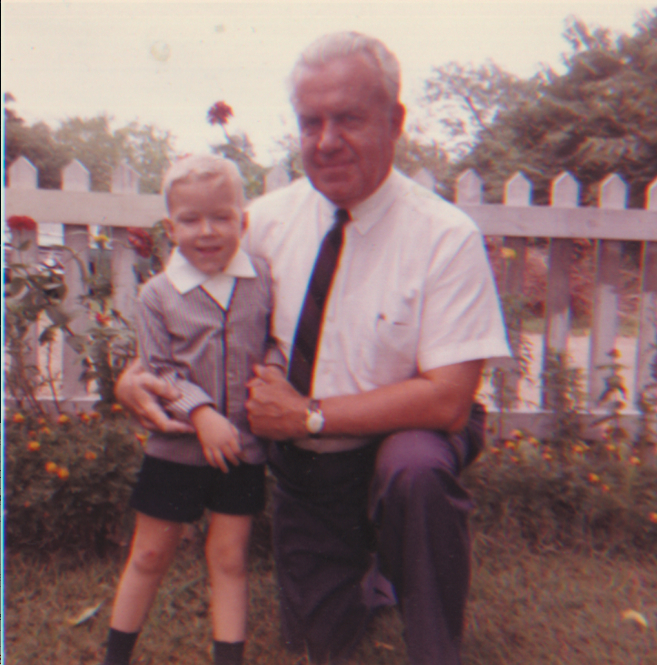
I wake with a feeling of unease nearly every morning these days as the world inches closer to the unthinkable.
Unlike many people I know I am personally very familiar with just how those advocating the use of nuclear weapons and the predictions of starvation think. No amount of death in pursuit of their goals is too gruesome to implement. That is why I wake in horror.
“You have to drop a nuclear bomb on Hanoi,” my mother’s father yelled into the receiver as he spun around his Needham, Massachusetts den surrounded by the 63 framed photos he took of the firebombing of Tokyo he snapped from a B29 flying at 20,000 feet above the smoldering death.
I watched him spend one afternoon after another pacing around his office in heated debates over the phone with his World War II friends, Curtis LeMay and Robert McNamara, demanding that the US drop a nuclear bomb on Hanoi to teach the communists that capitalism is boss.
He knew LeMay and McNamara from his days working in the Office of Strategic Services, the precursor to the Central Intelligence Agency, when he was directing Operation Meeting House from Burma. He let me know he had killed as many as a million Japanese civilians. He called this “a white man’s burden” that I would also have to “endure” when I came of age.
What first got my intention about preparations for a possible nuclear war was the Facebook posts in early February 2022 by Homeland Security.
They said:
Nuclear Explosion
Nuclear explosions can cause significant damage and casualties from blast, heat, and radiation but you can keep your family safe by knowing what to do and being prepared if it occurs.
A nuclear weapon is a device that uses a nuclear reaction to create an explosion.
Nuclear devices range from a small portable device carried by an individual to a weapon carried by a missile.
A nuclear explosion may occur with or without a few minutes warning.
Fallout is most dangerous in the first few hours after the detonation when it is giving off the highest levels of radiation. It takes time for fallout to arrive back to ground level, often more than 15 minutes for areas outside of the immediate blast damage zones. This is enough time for you to be able to prevent significant radiation exposure by following these simple steps:
GET INSIDE, STAY INSIDE, STAY TUNED and Prepare NOW.
Not a word about a nuclear war ending human life in the northern hemisphere.
Several weeks later the western media reported that President Vladimir Putin had ordered his military to put Russia’s nuclear deterrence forces on high alert.
The call for a direct conflict and a suggestion the US could and should use nuclear weapons against Russia was outlined in the long rambling essay, “The Price of Hegemony – Can America Learn to Use Its Power?”’ by Robert Kagan in the May 2022 issue of Foreign Affairs outlining the rationale for going to war with Russia. His wife is Victoria Nuland, Under Secretary of State for Political Affairs and the director of the US war effort in Ukraine.
Kagan writes, “It is better for the United States to risk confrontation with belligerent powers when they are in the early stages of ambition and expansion, not after they have already consolidated substantial gains. Russia may possess a fearful nuclear arsenal, but the risk of Moscow using it is not higher now than it would have been in 2008 or 2014, if the West had intervened then.”
In an intercepted phone conversation between Kagan’s wife, then Assistant Secretary of State Victoria Nuland and the US Ambassador to Ukraine, Geoffrey Pyatt, published before the violent coup that installed Yatseniuk as president:
Nuland: Good. I don’t think Klitsch should go into the government. I don’t think it’s necessary, I don’t think it’s a good idea.
I think Yats is the guy who’s got the economic experience, the governing experience. He’s the… what he needs is Klitsch and Tyahnybok on the outside. He needs to be talking to them four times a week, you know. I just think Klitsch going in… he’s going to be at that level working for Yatseniuk, it’s just not going to work.
Nuland: So on that piece Geoff, when I wrote the note [US vice-president’s national security adviser Jake] Sullivan’s come back to me VFR [direct to me], saying you need [US Vice-President Joe] Biden and I said probably tomorrow for an atta-boy and to get the deets [details] to stick. So Biden’s willing.
Pyatt: OK. Great. Thanks.
Biden, Sullivan and Nuland are still running the Ukrainian war against Russia and now their administration is floating the idea that we can survive a nuclear conflict and that we may need to strike first.
“Given the potential desperation of President Putin and the Russian leadership, given the setbacks that they’ve faced so far militarily, none of us can take lightly the threat posed by a potential resort to tactical nuclear weapons or low yield nuclear weapons,” US CIA Director Bill Burns said in public remarks at Georgia Tech on April 14, 2022.
A day later CNN airs an interview with Ukrainian President Zelensky writing that, “all of the countries of the world” should be prepared for the possibility that Russian President Vladimir Putin could use tactical nuclear weapons in his war on Ukraine.
And if normalizing nuclear war isn’t frightening enough we now have to worry about hunger. “We did talk about food shortages and it’s going to be real”, Biden said at a news conference in Brussels during the meeting of the G-7. “The price of the sanctions is not just imposed upon Russia. It’s imposed upon an awful lot of countries as well, including European countries and our country as well.”
Santa Cruz Food Not Bombs is already experiencing both an increase in people joining us for our daily meal and a reduction in food donations that Second Harvest Food Bank and local groceries report is due to supply chain disruptions.
Even before the war in Ukraine, food banks were warning of an increase in hunger. In January CNN aired a story called “Hunger in America could get worse as supply chains tighten”.
Two weeks later the Washington Post published a story “An invasion of Ukraine could drive up global food prices and spark unrest far from the front lines.”
“Should peace not prevail, western-gazing Ukrainians would pay the highest price. But in a worst-case scenario, the cost of a major Russian invasion of Ukraine — one of the world’s largest grain exporters — could ripple across the globe, driving up already surging food prices and increasing the risk of social unrest well beyond Eastern Europe.”
So peace did not prevail and food costs were already increasing to the point that many American families are suffering.
This is of course the perfect time for the City of Santa Cruz to pass an ordinance restricting protest against war, poverty and the sharing of food.
The more restrictive changes added to the Santa Cruz Municipal Code Chapter 10.65 ordinance regulating Public Gathering and Expression Events passed at a Zoom City Council meeting on April 14, 2022, include:
Which will C) Will result in the placement of structures or objects on streets or, sidewalks, or other pedestrian walkways exceeding twelve square feet in size or six feet in height; and/or(e) Which in may result in donations for nonprofit organizations; and/orD) Is conducted on a regularly scheduled basis at a single location for more than two consecutive days per week.
(f) It shall be a misdemeanor for a public gathering and expression event participant to fail or refuse to comply with a revocation order made pursuant to Section 10.65.240, 10.65.270, or 10.65.280.(g) Any violation of this Chapter, in addition to the penalties set forth in this section, is hereby declared a public nuisance and may be abated by any method authorized under Title 4 of this Code including, but not limited to, by civil injunction in accordance with Section 4.04.020.
The US plans to spend $34.4 billion to modernizing its nuclear warfare capability according to the US Defense Department’s 2023 budget or approximately the cost that the US Housing and Urban Development claims would house all of America’s homeless.
This is that moment when the four decades long campaign by Food Not Bombs must have an impact on the policies of governments that have until now made a priority of war over the security of food, housing and other domestic needs.
I can understand how difficult it is to contemplate the dark future that the Biden administration has set out before us but we must if we have any hope of survival. These monsters in power are willing to use nuclear weapons and that is why they are promoting the illusion that we can survive it while providing the justification for a preemptive first strike.
They are also willing to starve billions of people including those of us here in the United States that they have long perceived as “useless eaters”.
It is time we unite and force the redirection of our national resources from the military to food, housing, education, healthcare and other social services. Exactly the demands that caused the FBI – Joint Terrorism Task Force to declare Food Not Bombs a “credible national security threat” on August 29, 1988.
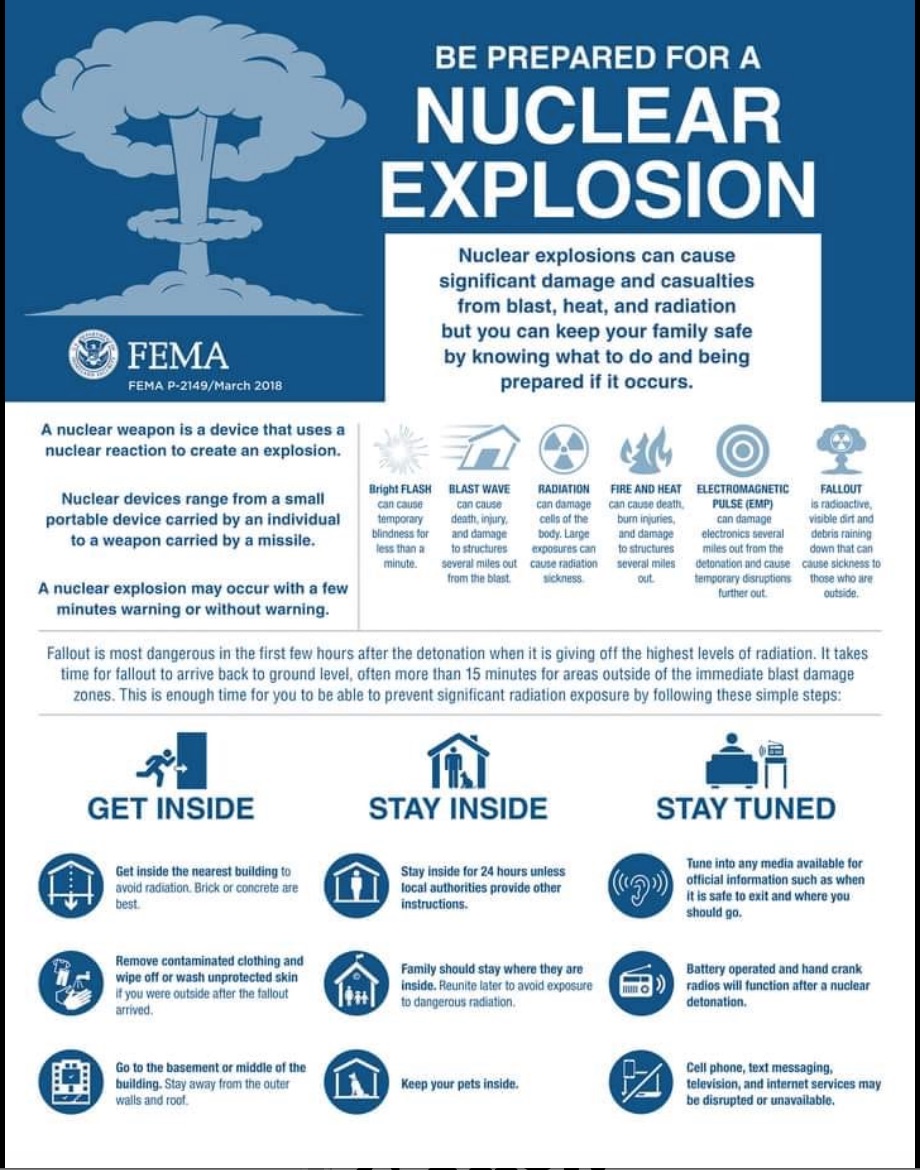
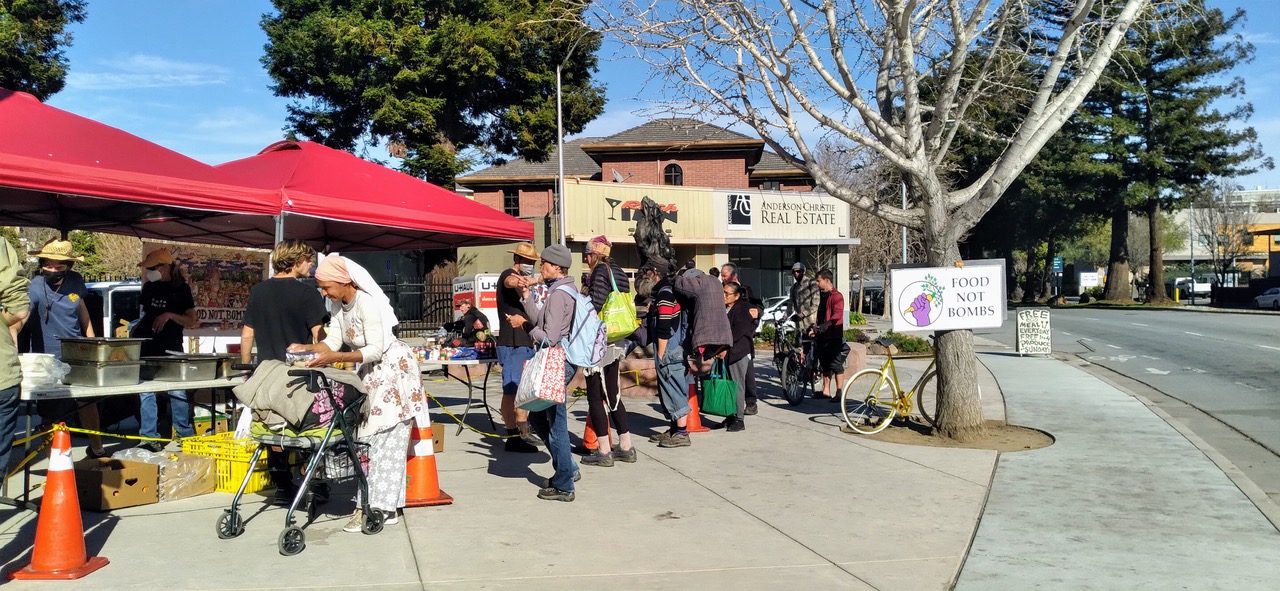
Celebrating 2 years of sharing food everyday with live music by Johnny and the Free Thinkers
Sunday, March 13, 2022
Noon to 4:00 PM
At the Town Clock where it all began
Pacific Avenue and Water Streets, Santa Cruz, California
Sharing food is always and unregulated gift of love. Please write and call the City of Santa Cruz and let them know you support the daily meals provided by Food Not Bombs. (831) 420-5020 • citycouncil@cityofsantacruz.com
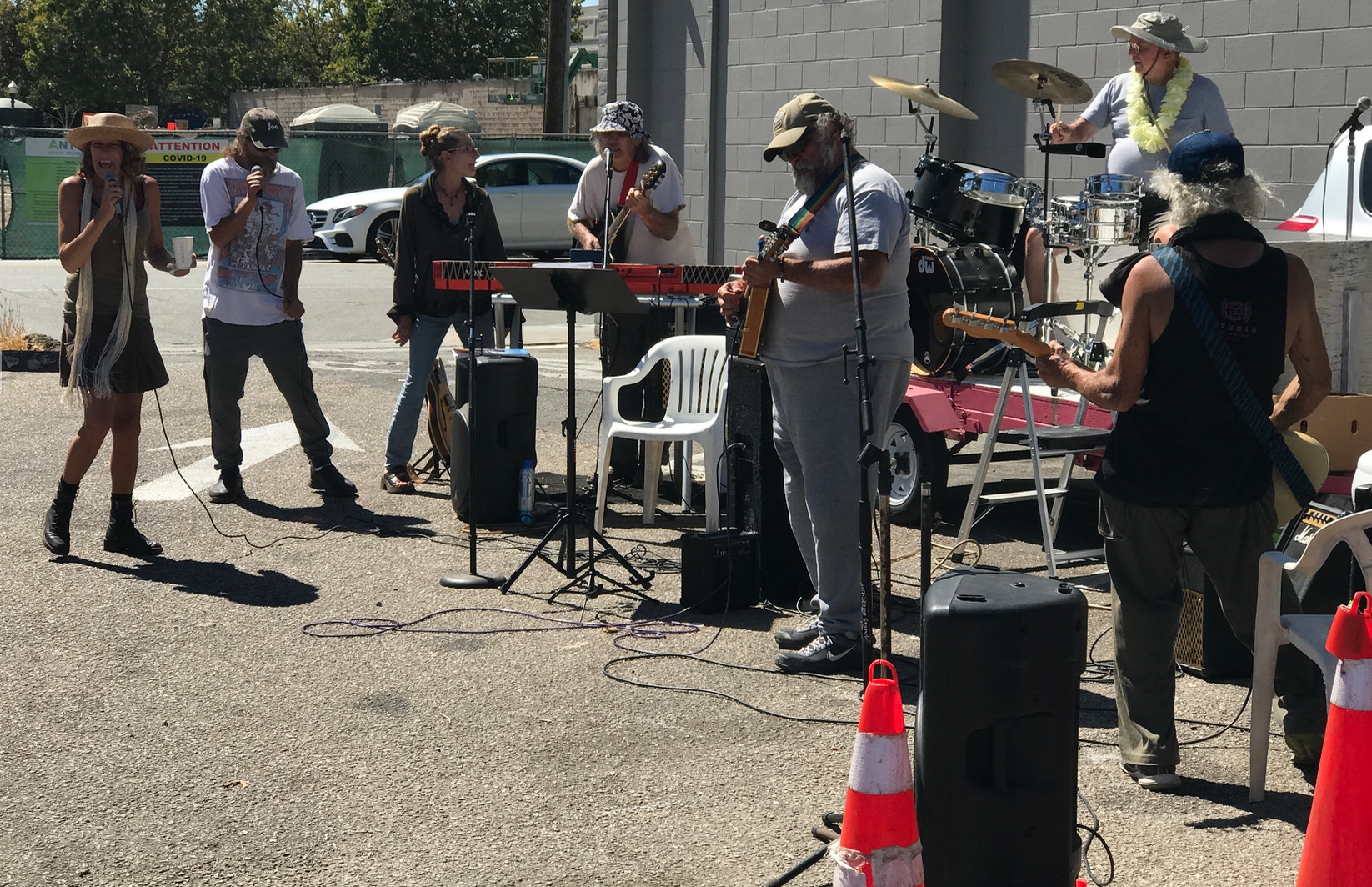
THANK YOU SANTA CRUZ – We couldn’t have done it without you.
The all volunteer group Food Not Bombs thanks the people of Santa Cruz for two years of support during the pandemic. We could not have done it without you!
On March 14, 2020, we learned that all the indoor food programs would be closed because of the COVID-19 crisis so we stepped in to take their place and started to share our meals seven days a week thinking we would return to our weekend schedule as soon as the pandemic was over in a month or two. Two years on those programs are still not able to provide the hot meals they had before the lockdowns.
Thankfully our community stepped up. Hundreds of local people have helped bring donations of food, clothing and survival gear to help us meet the needs of those who live outside or are struggling to maintain housing. Others have chipped in $5, $10 and $20 dollar donations to help us buy pup tents, car batteries and repair to support our effort to save people’s vehicular homes from being seized by the city.
Our unhoused friends help us set up and break down every day. College students from Cabrillo and UCSC join our team to help serve our seven to ten course meal. Local herbalists have provided tea. Area farmers truck in fresh harvests. Second Harvest, Trader Joes, Gayle’s Bakery, Beckmann’s, Grey Bears and local farmer’s markets are among those who provided our food.
Advanced Auto interrupted their schedule to fix our van several times so we wouldn’t miss providing that day’s meal. The Tabby Cat Cafe grounds our donations of coffee beans. The staff at Big Five Sporting Goods seeks ways to give us discounts for tents so we could afford as many as possible. Stolts Signs helped us replace the signs and banners taken from us by members of Take Back Santa Cruz. The workers at Santa Cruz Restaurant Supply make sure we have the equipment we require to keep our kitchen humming. Bernie and the kind office staff at Azzie’s Storage jumped into action to move our shipping containers every time we were evicted.
The security guards at New Leaf and their staff lifted our five gallon water bottles into shopping carts when back injured Keith is tasked with the job and dozens of people passing through the New Leaf parking lot have helped him load those heavy jugs into our vehicles. Others were happy to be stopped on the street to help lift urns of coffee into our van at the Little Red Church.
India Joze has contributed their kitchen, their refrigeration and thousands of hours of labor to help make sure a healthy meal is served everyday. Tom at University Copy donated reams of printing. The staff at WorldCentric has gone out of their way to supply us with cases of compostable paper products. Our good friend, Eric Fawcett, a local retired master plumber constructs our DIY hand washing stations and repairs the faucets at our kitchen. The staff at the Homeless Garden Project made vegan burritos and sandwiches. Barrios Unidos helped store dozens of pallets of dry goods before we purchased our second Conex box. Musicians perform at our meals. The drivers at Meals on Wheels drop off their extra food. Encompass social workers help us calm the emotionally distressed. Our friends at the Court Community Service Program send us waves of volunteers. Church people deliver cases of socks. A small army of supporters share our messages on line.
We even get clandestine help from city and county workers. The number of ways the people of Santa Cruz have helped us provide the most reliable source of support for communities poor and unhoused cannot be detailed in one short article. You can thank them for saving downtown Santa Cruz from suffering the damage that would result if people had no other way to get food became so desperate that they had to resort to extra-legal means to eat.
We have a dedicated core of volunteers who know what is required to provide healthy hot meals, groceries, drinking water and survival gear to hundreds of people everyday.
We haven’t been sitting at computers collecting $100k+ salaries like those at city hall and the county buildings who spend their time evicting us from one location after another in their campaign to attract hedge-fund property speculators to ravage our community.
We have been volunteering for free on the streets of Santa Cruz everyday of this pandemic responding to the hunger and emotional stress of those living outside.
While the city is busy facilitating the wishes of global hedge funds and out of county property speculators we have been preparing for the unfolding crisis of evictions and the dramatic increase in hunger. We raised money to buy three shipping containers to stockpile dry goods and equipment. We have invested in reliable sources of fresh water. Our group has organized systems to maintain a daily response to the escalating disaster working in teams.
One team coordinates the preparation and cooking of 150 to 200 hot meals a day. Another team recovers our scraps to compost at the Homeless Garden and that team also takes the cardboard to Grey Bears.
We have two shifts of drivers. The opening shift starts by bring the hot water for our hand-washing station, sanitizing buckets to clean our tables, serving equipment and the first round of coffee. They open one of our shipping containers and set up the canopies, tables, social distancing cones, signs and banners. Yesterday’s bread and the survival gear that was not distributed the day before is brought to the sanitized tables along with our pre-meal snacks, creamer, sugar and paper products.
A team of servers complete the setup and the madness of four hours of food service and compassion begins.
That opening driver returns to the kitchen to collect six to eight five gallon hotel trays of that day’s hot meal, another five gallons of tossed salad and fruit salad.
Another team orders two or three pallets of food from Second Harvest and recovers food from the farmers markets, local grocery stores and bakeries. Then much of this food is taken to one of our three shipping containers and our kitchen. At least one pallet is taken to the people at the Benchlands along with our five gallons of drinking water and another load is distributed to undocumented families.
Yet another team orders the paper products, cooking oil and coffee, receives the deliveries and packs them into our rented storage units, the kitchen or one of our Conex boxes.
Finally the closing team sanitizes the tables, packs the empty hotel trays and coffee urns into the van. The tables, canopies, signs, banners, unused paper products, left over bread and survival gear were packed into the shipping container or as of late into our rented U-Haul trailer. That team also picks up all the trash left around the area during the day, sweeps up the site and scrubs the food stains off the pavement. That team bags all the garbage and takes it to the dumpster we rent at the Little Red Church. Then they return to the kitchen to wash and sanitize our serving equipment and hotel trays ending the day by giving the kitchen a thorough cleaning.
We pay a cleaning company to do a deep clean of the kitchen at the first of each month.
This all repeats again day in and day out for nearly 730 days now.
Please join us on Sunday, March 13, 2022, accept our thanks to the people of Santa Cruz for making all this possible.
Santa Cruz Food Not Bombs
PO Box 422
Santa Cruz, CA 95061 USA
santacruz.foodnotbombs.net
menu@foodnotbombs.net
1-800-884-1136
THANK YOU SANTA CRUZ
February 27, 2022
We couldn’t have done it without you
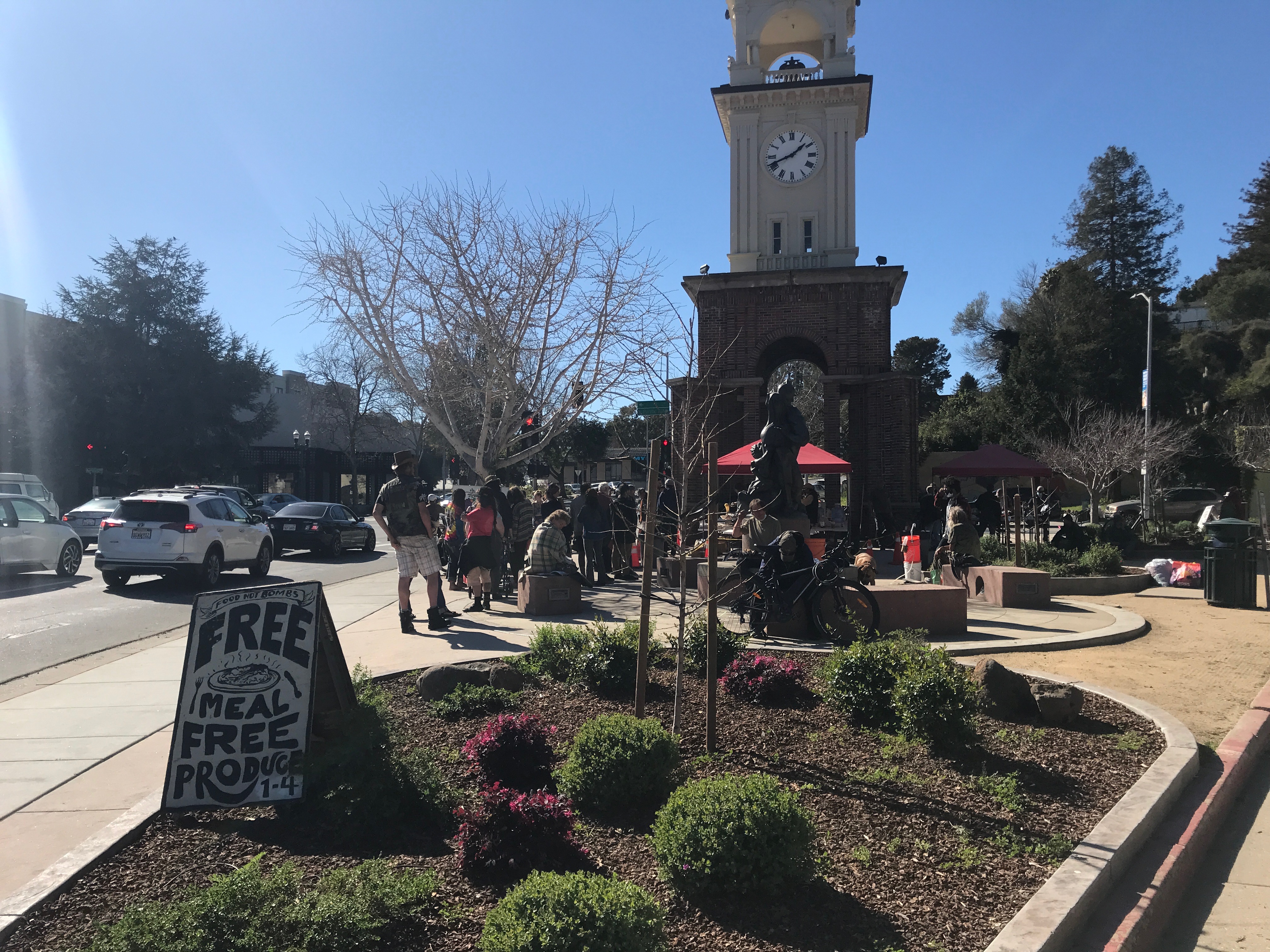
Join us in our celebration with live music by Johnny and the Free Thinkers
Sunday, March 13, 2022 • Noon to 4:00 PM at the Town Clock where it all began
Pacific Avenue and Water Streets, Santa Cruz, California
The all volunteer group Food Not Bombs thanks the people of Santa Cruz for two years of support during the pandemic. We could not have done it without you!
On March 14, 2020, we learned that all the indoor food programs would be closed because of the COVID-19 crisis so we stepped in to take their place and started to share our meals seven days a week thinking we would return to our weekend schedule as soon as the pandemic was over in a month or two. Two years on those programs are still not able to provide the hot meals they had before the lockdowns.
Thankfully our community stepped up. Hundreds of local people have helped bring donations of food, clothing and survival gear to help us meet the needs of those who live outside or are struggling to maintain housing. Others have chipped in $5, $10 and $20 dollar donations to help us buy pup tents, car batteries and repair to support our effort to save people’s vehicular homes from being seized by the city.
Our unhoused friends help us set up and break down every day. College students from Cabrillo and UCSC join our team to help serve our seven to ten course meal. Local herbalists have provided tea. Area farmers truck in fresh harvests. Second Harvest, Trader Joes, Gayle’s Bakery, Beckmann’s, Grey Bears and local farmer’s markets are among those who provided our food.
Advanced Auto interrupted their schedule to fix our van several times so we wouldn’t miss providing that day’s meal. The Tabby Cat Cafe grounds our donations of coffee beans. The staff at Big Five Sporting Goods seeks ways to give us discounts for tents so we could afford as many as possible. Stolts Signs helped us replace the signs and banners taken from us by members of Take Back Santa Cruz. The workers at Santa Cruz Restaurant Supply make sure we have the equipment we require to keep our kitchen humming. Bernie and the kind office staff at Azzie’s Storage jumped into action to move our shipping containers every time we were evicted.
The security guards at New Leaf and their staff lifted our five gallon water bottles into shopping carts when back injured Keith is tasked with the job and dozens of people passing through the New Leaf parking lot have helped him load those heavy jugs into our vehicles. Others were happy to be stopped on the street to help lift urns of coffee into our van at the Little Red Church.
India Joze has contributed their kitchen, their refrigeration and thousands of hours of labor to help make sure a healthy meal is served everyday. Tom at University Copy donated reams of printing. The staff at WorldCentric has gone out of their way to supply us with cases of compostable paper products. Our good friend, Eric Fawcett, a local retired master plumber constructs our DIY hand washing stations and repairs the faucets at our kitchen. The staff at the Homeless Garden Project made vegan burritos and sandwiches. Barrios Unidos helped store dozens of pallets of dry goods before we purchased our second Conex box. Musicians perform at our meals. The drivers at Meals on Wheels drop off their extra food. Encompass social workers help us calm the emotionally distressed. Our friends at the Court Community Service Program send us waves of volunteers. Church people deliver cases of socks. A small army of supporters share our messages on line.
We even get clandestine help from city and county workers. The number of ways the people of Santa Cruz have helped us provide the most reliable source of support for communities poor and unhoused cannot be detailed in one short article. You can thank them for saving downtown Santa Cruz from suffering the damage that would result if people had no other way to get food became so desperate that they had to resort to extra-legal means to eat.
We have a dedicated core of volunteers who know what is required to provide healthy hot meals, groceries, drinking water and survival gear to hundreds of people everyday.
We haven’t been sitting at computers collecting $100k+ salaries like those at city hall and the county buildings who spend their time evicting us from one location after another in their campaign to attract hedge-fund property speculators to ravage our community.
We have been volunteering for free on the streets of Santa Cruz everyday of this pandemic responding to the hunger and emotional stress of those living outside.
While the city is busy facilitating the wishes of global hedge funds and out of county property speculators we have been preparing for the unfolding crisis of evictions and the dramatic increase in hunger. We raised money to buy three shipping containers to stockpile dry goods and equipment. We have invested in reliable sources of fresh water. Our group has organized systems to maintain a daily response to the escalating disaster working in teams.
One team coordinates the preparation and cooking of 150 to 200 hot meals a day. Another team recovers our scraps to compost at the Homeless Garden and that team also takes the cardboard to Grey Bears.
We have two shifts of drivers. The opening shift starts by bring the hot water for our hand-washing station, sanitizing buckets to clean our tables, serving equipment and the first round of coffee. They open one of our shipping containers and set up the canopies, tables, social distancing cones, signs and banners. Yesterday’s bread and the survival gear that was not distributed the day before is brought to the sanitized tables along with our pre-meal snacks, creamer, sugar and paper products.
A team of servers complete the setup and the madness of four hours of food service and compassion begins.
That opening driver returns to the kitchen to collect six to eight five gallon hotel trays of that day’s hot meal, another five gallons of tossed salad and fruit salad.
Another team orders two or three pallets of food from Second Harvest and recovers food from the farmers markets, local grocery stores and bakeries. Then much of this food is taken to one of our three shipping containers and our kitchen. At least one pallet is taken to the people at the Benchlands along with our five gallons of drinking water and another load is distributed to undocumented families.
Yet another team orders the paper products, cooking oil and coffee, receives the deliveries and packs them into our rented storage units, the kitchen or one of our Conex boxes.
Finally the closing team sanitizes the tables, packs the empty hotel trays and coffee urns into the van. The tables, canopies, signs, banners, unused paper products, left over bread and survival gear were packed into the shipping container or as of late into our rented U-Haul trailer. That team also picks up all the trash left around the area during the day, sweeps up the site and scrubs the food stains off the pavement. That team bags all the garbage and takes it to the dumpster we rent at the Little Red Church. Then they return to the kitchen to wash and sanitize our serving equipment and hotel trays ending the day by giving the kitchen a thorough cleaning.
We pay a cleaning company to do a deep clean of the kitchen at the first of each month.
This all repeats again day in and day out for nearly 730 days now.
Please join us on Sunday, March 13, 2022, accept our thanks to the people of Santa Cruz for making all this possible.
PLEASE CONTACT THE CITY COUNCIL OF SANTA CRUZ
The city wants to evict Food Not Bombs from the Town Clock
Sharing food is always an unregulated gift of love.
Let the City of Santa Cruz know you support
Food Not Bombs and our continued
service at the Town Clock
(831) 420-5020
citycouncil@cityofsantacruz.com
SANTA CRUZ THREATENS TO EVICT FOOD NOT BOMBS
January 9, 2022
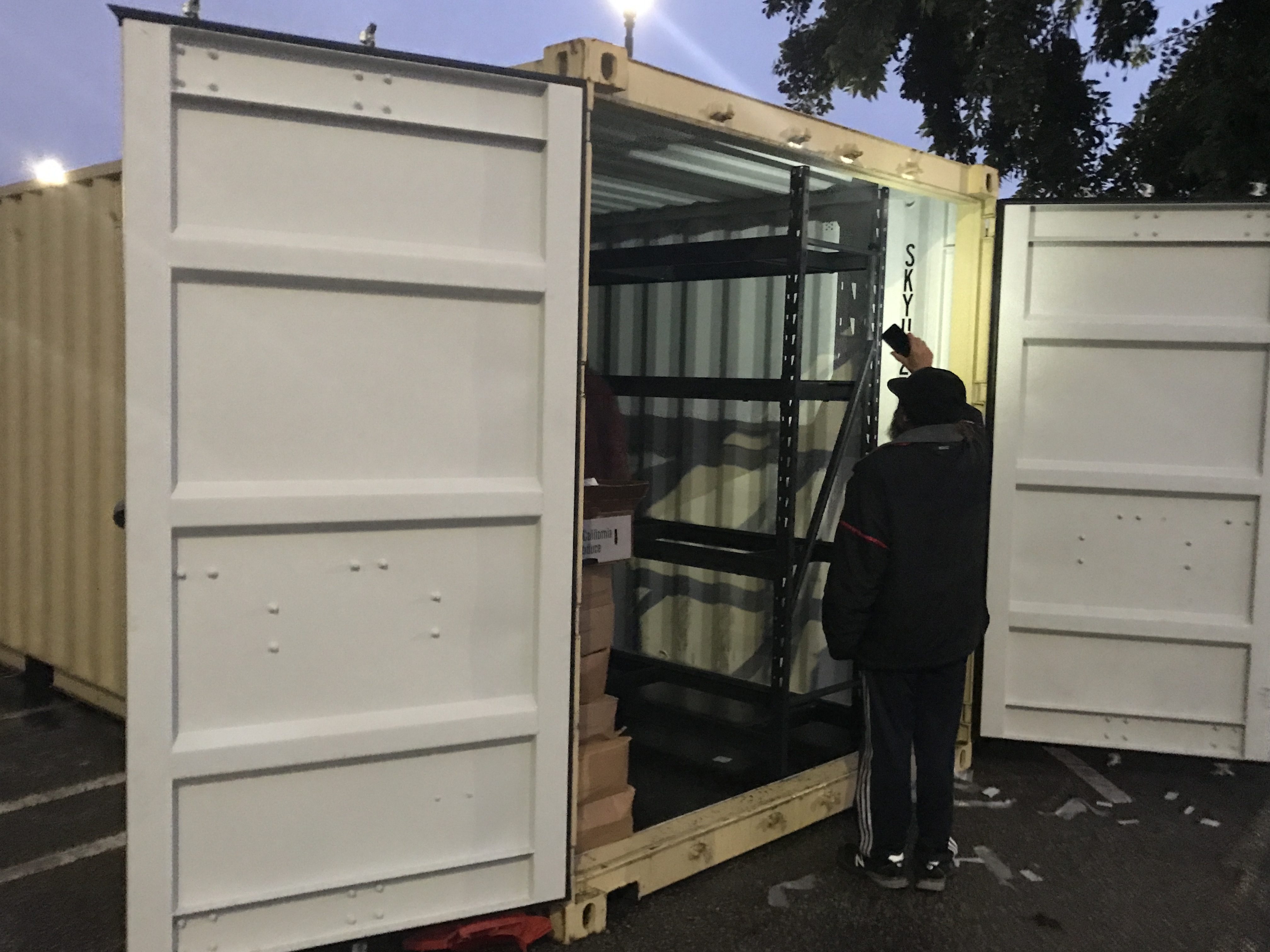
Protest Tuesday, January 11, 2022, noon at Laurel and Front Streets, Santa Cruz, California Let the City of Santa Cruz know how you feel about their hostility towards Food Not Bombs:
citycouncil@cityofsantacruz.com
It is 3:30 pm on Friday, January 7, 2022, when I finally get a call from Larry Imwalle, the Santa Cruz City Homelessness Response Manager. He never returned my calls about moving people to higher ground before the Benchlands flood or after my desperate efforts to get two families in to housing. He is paid $150,000 a year to “manage the homeless.”
I was buying two more sets of Industrial Steel Shelving at Home Depot to place in our new shipping container. We are rushing to remove our back stock of rice, lentils and other dry goods from India Joze’s Restaurant before he closes down to make way for a luxury apartment complex to be built in its place.
“I’m following up on our phone conversation a few minutes ago, in which I let you know that the City will require that Food Not Bombs (FNB) vacate Lot 27 by Tuesday, January 11, 2022 at 2:00 PM”
Larry tells me as can be read in his email that, “The Pure Water Soquel Construction Project will be working in this area and requires use of Lot 27 and the surrounding area to accomplish the project and stage equipment. “ I suggested he have the project manager call me so we can make this work and pointed out that there is another parking lot next to Wheelworks that is always vacant.
As soon as Larry and I hang up I start getting calls from our volunteers at Lot 27. The police have arrived and are handing out papers saying we have to leave by Tuesday.
This is not the first late Friday afternoon eviction from Lot 27 during our 664 days of sharing meals with the community during the pandemic.
We received notice late Friday, October 2, 2020, that we would have to move to the lot across Front Street because the need to use it to park construction equipment for a levee project. We did move across the street. The city fenced off Lot 27 and three months later not one piece of construction equipment was ever placed on the lot. A New Years Eve march removed the fence and returned it to the police department steps and we have been sharing food there at Lot 27 everyday since.
The police told our volunteers and those camping around our meal that we have to go to the flooded Benchlands.
The number of just evicted is increasing and the increase in those seeking food is shocking but expected as the economy for working people fails. We distributed $2,000 in cheap pup tents in December. It is heartbreaking to see the desperation in peoples faces and learn there is no place for them to sleep. People cry with relief when you hand them their tent.
Our volunteers have been preparing for this increase for months seeking a location for our third shipping container and lining up more sources of food. We have had to increase our orders of paper products and deliveries of dry goods to share with the people at the Benchlands and Depot Park.
If we stopped providing food for even one week it is likely the over 400 people who depend on us every day would be forced to seek extra legal means to meet their needs. This would not be good for anyone.
The city has no business interfering with Food Not Bombs. We are not stopping them from feeding the hungry.
Let the City of Santa Cruz know how you feel about their hostility towards Food Not Bombs:
citycouncil@cityofsantacruz.com
Please contact Food Not Bombs at 575-770-3377 or menu@foodnotbombs.net
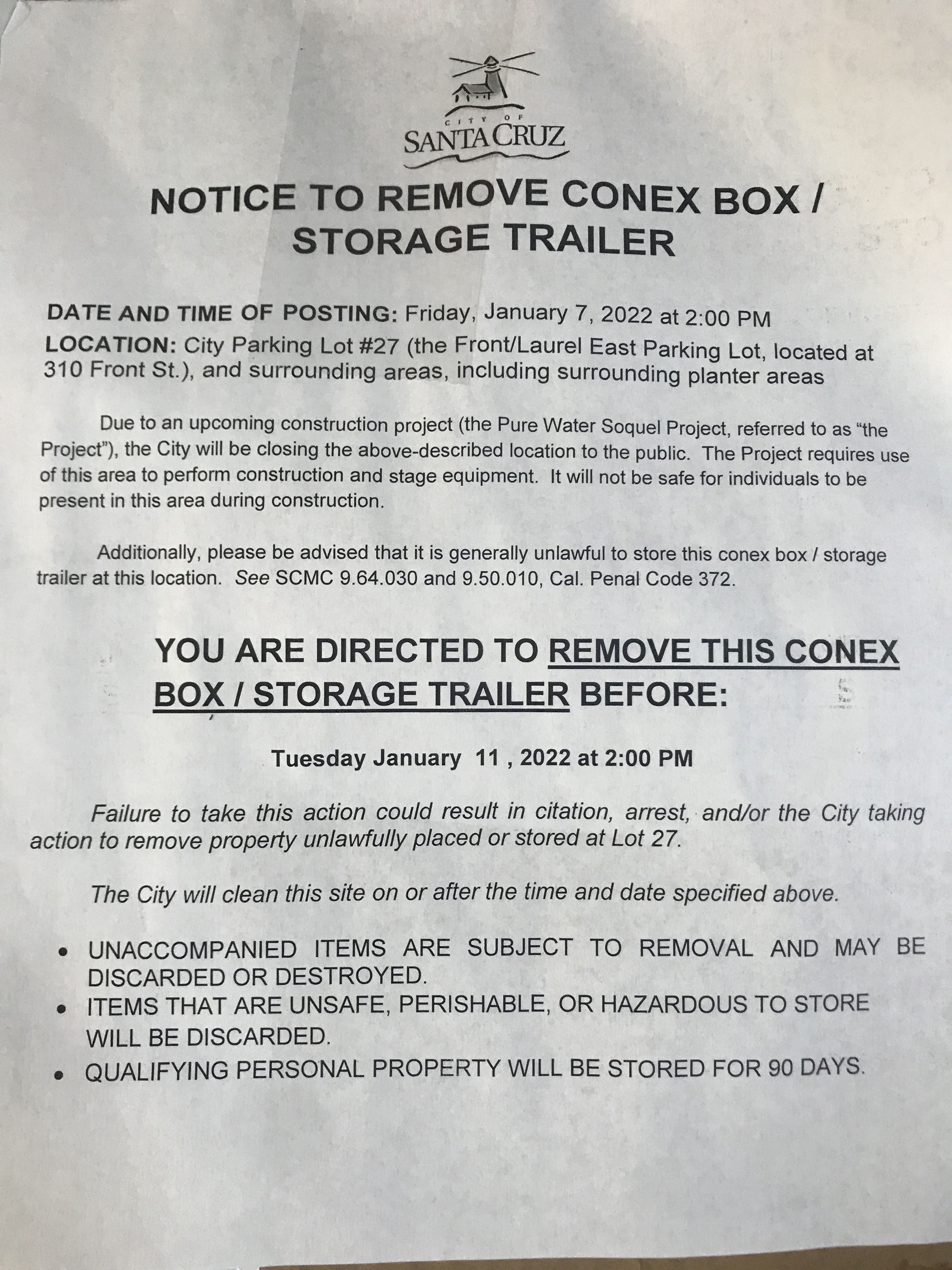
Dear Keith,
I’m following up on our phone conversation a few minutes ago, in which I let you know that the City will require that Food Not Bombs (FNB) vacate Lot 27 by Tuesday, January 11, 2022, at 2:00 PM.
The factors impacting this decision are as follows:
· The Pure Water Soquel Construction Project will be working in this area and requires use of Lot 27 and the surrounding area to accomplish the project and stage equipment. Due to the construction project, it will not be safe for FNB to continue its operations in Lot 27, and the City will be closing this property to the public.
· FNB’s continuous presence in this lot, including storage of the Conex box in the lot, is simply illegal and not permitted by the City. See SCMC 9.64.030 and SCMC 9.50.010.
Accordingly, the City requires that FNB must vacate Lot 27 and remove the shipping container / Conex Box located on Lot 27 by 2:00 pm on Tuesday January 11, 2022. Failure to take these actions could result in citation, arrest, and/or the City taking action to remove property unlawfully placed or stored at Lot 27.
Thank you for your attention to this communication, and I’d be happy to answer any questions you may have.
Sincerely,
Larry
Larry Imwalle
Homelessness Response Manager
City Manager’s Office | City of Santa Cruz
809 Center Street, Room 10 | Santa Cruz, CA 95060
831-420-5405
LImwalle@cityofsantacruz.com
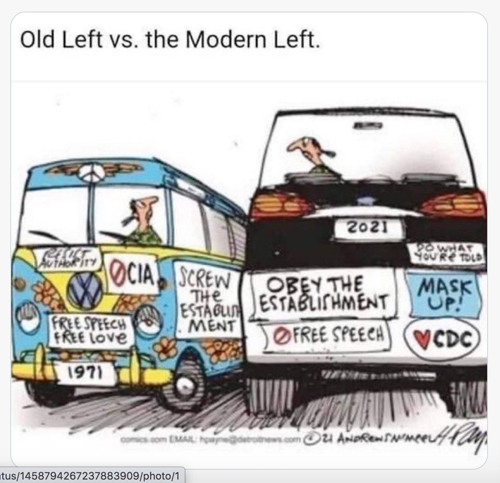
Looking at COVID as a Progressive
I can understand wanting to get the COVID injections and I support your right to do so. The fear of death from COVID is compelling. The images and reports frightening. I would never interfere with someone’s desire to participate in these vaccine trials. I can understand how much more terrifying the world looks to those who quarantined at home for weeks relying on social media, NPR, CNN and the New York Times for information unaware of the reality on the streets. Had I been inside quarantined I may have also internalized that fear and found a logic in the ever changing information about COVID, the vaccines and the boosters.
As progressives I think we should be standing against attacks on our freedoms and supporting the civil rights of all essential workers, people who like myself spent every day of the pandemic outside meeting the needs of our community. I would think that my anti-war, anti-capitalist friends would be open to questioning the story about COVID since it is being pushed by the same people who also told us there were WMDs in Iraq and that we were winning the war on Afghanistan.
I first wrote a letter on this subject when I received an invitation to attend a meeting forming a new progressive alliance. To participate you had to provide proof of a vaccination or a negative COVID test. I wrote to invite the progressive community to stand in solidarity with the working class by refusing to meet in facilities that demand proof of participation in the vaccine experiments.
I had shrugged off the proof of vaccine requirement to attend the ACLU awards ceremony since I had to cook that day. But when I came to understand that the outdoor venue for the meeting did not require this proof, nor does the Simpkins Family Center where the progressive alliance meets this week nor the Del Mar Theater where I was barred from seeing a film that I was in, I became even more concerned.
Initially the demand for proof of vaccination or negative test may have seemed reasonable to those implementing the policy based on the messaging allowed in the media and on-line platforms. Since so much scientific debate has been censored to protect the profits and power of those institutions pushing the vaccines it is easy to understand why such measures would be considered.
Those local progressives initiating these policies are well meaning I am sure, thought it would slow the spread of COVID and I believe had no idea what role they were playing in implementing the first of what could become an ever tighter noose choking what is left of our freedom and democracy.
I remained silent about my objections to COVID policies, self censoring to protect the global movement Food Not Bombs from smears and a withdrawal of support. That was until I was personally impacted by demands by my friends for me to prove my vaccination status.
I have been organizing against corporate power, censorship, the military and the CIA for 50 years and plan to continue
I helped start the Santa Cruz Homeless Union COVID-19 Relief Center and Food Not Bombs meal. Like many I was freaked out about COVID in those early days and even spent $20,000 of my own money on hotel rooms for the homeless worried that if my friends were not indoors and quarantined, they could die. Food Not Bombs organized our first COVID safety meeting at LuLus the morning of March 14, 2020. My seven bleach-stained teeshirts illustrate the hours I spent sanitizing our equipment. I posted the latest California Health Department safety measures on the Food Not Bombs website starting in early April 2020. The fading six foot apart circles I spray painted at the Town Clock and Garage10 and the white dashes that decorate Lot 27 are a testament to my concern. So I can understand the fear people have of COVID. I can understand wanting to get the injections and again I support your right to do so.
Things started to change for me when I first heard about Trump’s secret military program Warp Speed, and became concerned that the vaccine program may not be about health. The six or seven NPR programs a day about massive COVID deaths and the rush to get everyone a vaccine also made me suspect there was another agenda.
Like many of you, when I saw people called anti-vaxxers armed with AR-15s waving confederate and Trump flags I was horrified. There is no way I would ever join people like the Proud Boys and Trump supporters in protesting the lockdowns and other COVID policies. The questioning of Dr Fauci was framed as a position taken only by racist gun- toting Trump supporters effectively driving the left into the arms of the military and big Pharma.
My dear friend and virologist, Dr. Shannon Murray came to visit in November 2020. I knew her when she was helping develop the Moderna vaccine at the National Institute of Health in Bethesda, Maryland. She feared there could be major health problems from the vaccines since the first human trials had not taken place yet and more study was needed before they could be considered safe in humans. The animal trials had not been promising at that point, killing nearly 80% of those vaccinated animals who were exposed to SARS-CoV-1. She also expressed concern that the research in these vaccines had become a secret military program when her access to data had suddenly been removed. At that time she was still using an alias as did her coworkers so they could share their concerns without fear of being banned from their life’s work. Like many at the NIH, she refuses to get a jab.
Until that time I had the impression I was one of only a couple of progressives that thought something wasn’t right. I would slowly learn that several other left friends also shared my perspective. I connected Shannon to an old journalist friend, Sam Hussini who had been writing on gain of function research and bio-warfare at places like the Fort Detrick Biological Warfare Laboratories. I learned that another colleague of mine, the director of the Organic Consumers Association, Ronnie Cummings and my friend Vandana Shiva were also starting to express concerns that mirrored our work together against Monsanto. So even though I remained publicly silent I started to feel less alone.
We now see that the vaccines do not protect from the spread of COVID or protect us from becoming ill from COVID. I have a number of friends who contracted COVID from a fully vaccinated person. To highlight the failure of the vaccines the Santa Cruz Health Department reported that four fully vaccinated people, one partially vaccinated person and three unvaccinated people died of COVID in our county during October 2021. The unvaccinated may have been classified as such because they had their last jab less than two weeks before their death or they had not had a booster or maybe they had not had any vaccination for COVID.
Now things are getting scary. I never thought my friends would feel justified in segregating me from their places of business or banning me from participating in their events. That was upsetting enough but now I have to face the possibility that these same friends will remain silent as those of us who are refusing the experimental jab are criminalized and possibly interned. When Austria announced plans to place all unvaccinated under house arrest I found that particularly unsettling.The open assault on the unvaccinated had started. News came that Australia had started to force the unvaccinated into quarantine camps followed by media reports that the Dutch police had fired live ammunition at unarmed anti-mandate and anti-lockdown protesters, shooting three people in Rotterdam. This has been followed by the lockdown of the unvaccinated in Germany and a call by the leaders of the European Union to force everyone in the Euro Zone to get a vaccine.
I believe that left progressives will be crushed if the current trend is not stopped. The very reasons a new Santa Cruz progressive alliance was proposed was to stop the gentrification of our community. The building of ghost condominiums is in coordination with the COVID policies that have closed small businesses letting hedge funds scoop up property. So far there has been no local, state or national plan to house the millions of Americans facing eviction. Will the unhoused be placed on military bases as suggested by former mayor Donna Myers? This push for control also includes a drive to pass H.R. 350: The Domestic Terrorism Prevention Act of 2021, which targets anti-capitalist, anarchists and other progressive activists like myself. Progressive voices questioning US interventions, the Occupation of Palestine or the increase in surveillance programs are now regularly removed from social media platforms. It won’t be long before Digital IDs are required to participate in commerce and your vaccine status could be linked to your income, access to education, health care and your personal freedom if we don’t unite now against the corporate clampdown.
Aren’t these the issues that we progressives have been organizing against?
As a progressive, I am still against censorship by groups like Henry Kissinger’s CIA dominated Atlantic Council, the Aspen Institute and Imran Ahmed who are tasked with deleting social media accounts that do not support the corporate agenda. I am also still against the exploitive corporations with a history of deceit and harm like Pfizer who has paid out billions in damages for their products that have killed or maimed. Why are we progressives defending the goals of global corporate power, the US military and the CIA by demanding proof of vaccination when we know they don’t work as advertised.
We should start our resistance by insisting that progressives only hold events in facilities where all working class people can participate regardless of vaccine status. As progressives we must also speak out against mandates, vaccine passports, segregation, the current increase in bio-warfare research, the domestic terrorism law and all censorship.
You may have seen video of the vaccinated in Italy burning their green vaccine passports in solidarity with the unvaccinated. We need such solidarity here in Santa Cruz.
 Anarchistcook's Weblog